
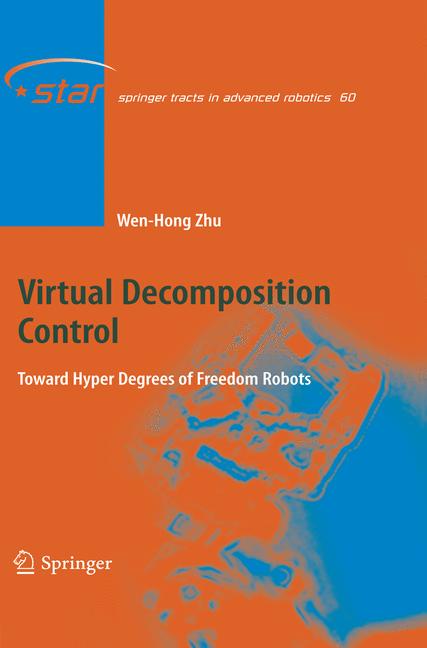
Virtual Decomposition Control
☆☆☆☆☆
(0 reviews)
Lowest price (incl. delivery)
118,50 GBP
Typical price3 129,87 PLN
Lowest (90 days)117,69 PLN
Offers2
Last updated4 zile în urmă
| Vânzător | Product price | Delivery | Total | Disponibilitate | Updated | |
|---|---|---|---|---|---|---|
| SP SpringerNatureLink Shop INT | 103,50 GBP | 15,00 GBP | 118,50 GBP | Disponibil | 5 zile în urmă | View offer |
| SP Springer Nature Author | 21 449,00 JPY | 25,00 JPY | 21 474,00 JPY | Disponibil | 4 zile în urmă | View offer |
Prețurile și disponibilitatea se pot modifica. Ultima actualizare: 08.08.2026 23:28.
0,0
☆☆☆☆☆
0 reviews
5★
0%
4★
0%
3★
0%
2★
0%
1★
0%
Product reviews
No reviews yet — be the first!
Driven by the need to achieve superior control performances for robots with hyper degrees of freedom, the virtual decomposition control approach is thoroughly presented in this book. This approach uses subsystem (such as links and joints of a complex robot) dynamics to conduct control design, while guaranteeing the stability and convergence of the entire complex robot without compromising the rigorousness of the system analysis. The central concept of this approach is the definition of the virtual stability. The stability of the entire complex robot is mathematically equivalent to the virtual stability of every subsystem. This fact allows us to convert a large problem to a few simple problems with mathematical certainty. This book comprises fourteen chapters. The first five chapters form the foundation of this approach. The remaining nine chapters are relatively independent. Starting from Chapter 6, each chapter deals with a particular type of systems including motor/transmission assemblies, hydraulic robots, coordinated multiple robots, space robots, humanoid robots, adaptive teleoperation, and modular robot manipulators. At the end, the extensions of this approach to distributed-parameter systems and to electrical circuits are given, paving the way for other applications to follow. This book is intended for practitioners, researchers, and graduate students who have acquired fundamental knowledge on robotics and control systems and have been committed to achieving the best control performances on complex robotics systems and beyond.
Similar products
 Patient Safety Coaching
from $91.97
Patient Safety Coaching
from $91.97
 Ethnography and Diversity
from $69.30
Ethnography and Diversity
from $69.30
 Smart Villages
from $91.97
Smart Villages
from $91.97
 Nuclear Non-Proliferation in International Law - Volume VI
from $91.97
Nuclear Non-Proliferation in International Law - Volume VI
from $91.97
 The Price of Freedom
from $91.97
The Price of Freedom
from $91.97
 Eco-Social Policy in the OECD and the World Bank
from $91.97
Eco-Social Policy in the OECD and the World Bank
from $91.97
 Special Topics in Policing
from $122.58
Special Topics in Policing
from $122.58
 Music from the Heart
from $91.97
Music from the Heart
from $91.97