
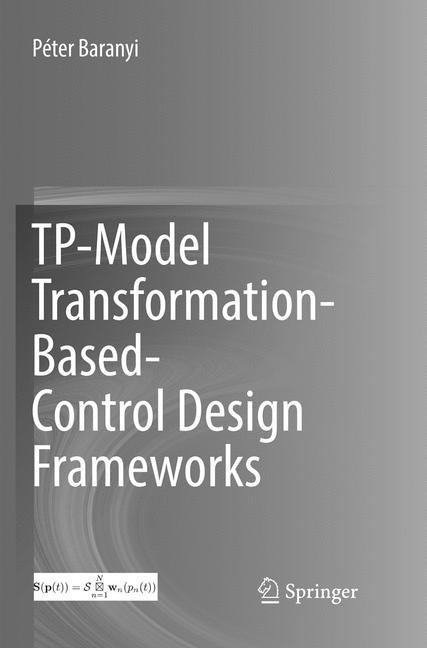
TP-Model Transformation-Based-Control Design Frameworks
☆☆☆☆☆
(0 reviews)
Lowest price (incl. delivery)
7 164,00 JPY
Typical price565,82 PLN
Lowest (90 days)35,99 PLN
Offers6
Last updated1 săptămână în urmă
Price history (90 days)
Full history
2026-08-08
2026-08-15
| Actualizat la | Preț |
|---|---|
| 2026-08-08 | 39,99 |
| 2026-08-14 | 35,99 |
| 2026-08-15 | 51,99 |
| Vânzător | Product price | Delivery | Total | Disponibilitate | Updated | |
|---|---|---|---|---|---|---|
| SP SpringerNatureLink Shop INT | 7 149,00 JPY | 15,00 JPY | 7 164,00 JPY | Disponibil | 4 zile în urmă | View offer |
| SP Springer Nature Author | 7 149,00 JPY | 15,00 JPY | 7 164,00 JPY | Disponibil | 1 săptămână în urmă | View offer |
| SP SpringerNatureLink Shop INT | 49,99 USD | 15,00 USD | 64,99 USD | Disponibil | 4 zile în urmă | View offer |
| SP SpringerNatureLink Shop INT | 54,99 USD | 25,00 USD | 79,99 USD | Disponibil | 4 zile în urmă | View offer |
| SP SpringerNatureLink Shop INT | 54,99 USD | free | 54,99 USD | Disponibil | 4 zile în urmă | View offer |
| SP SpringerNatureLink Shop INT | 59,00 EUR | 25,00 EUR | 84,00 EUR | Disponibil | 4 zile în urmă | View offer |
Prețurile și disponibilitatea se pot modifica. Ultima actualizare: 08.08.2026 23:08.
0,0
☆☆☆☆☆
0 reviews
5★
0%
4★
0%
3★
0%
2★
0%
1★
0%
Product reviews
No reviews yet — be the first!
This book covers new aspects and frameworks of control, design, and optimization based on the TP model transformation and its various extensions. The author outlines the three main steps of polytopic and LMI based control design: 1) development of the qLPV state-space model, 2) generation of the polytopic model; and 3) application of LMI to derive controller and observer. He goes on to describe why literature has extensively studied LMI design, but has not focused much on the second step, in part because the generation and manipulation of the polytopic form was not tractable in many cases. The author then shows how the TP model transformation facilitates this second step and hence reveals new directions, leading to powerful design procedures and the formulation of new questions. The chapters of this book, and the complex dynamical control tasks which they cover, are organized so as to present and analyze the beneficial aspect of the family of approaches (control, design,and optimization). Additionally, the book aims to convey simple TP modeling; a new convex hull manipulation based possibilities for optimization; a general framework for stability analysis; standardized modeling and system description; relaxed and universal LMI based design framework; and a gateway to time-delayed systems.
Similar products
 50 Years of Philosophy and Medicine
from $107.30
50 Years of Philosophy and Medicine
from $107.30
 Understanding Cybersecurity Law and Digital Privacy
from $122.63
Understanding Cybersecurity Law and Digital Privacy
from $122.63
 Decisions in International Trade and Logistics
from $122.63
Decisions in International Trade and Logistics
from $122.63
 Advances in Economic Measurement
from $122.63
Advances in Economic Measurement
from $122.63
 Nanomaterials
from $137.96
Nanomaterials
from $137.96
 Sustainable Scaffolds-based Strategies in Tissue Engineering and Regenerative Medicine
from $162.87
Sustainable Scaffolds-based Strategies in Tissue Engineering and Regenerative Medicine
from $162.87
 Narratives in Educational Research
from $162.87
Narratives in Educational Research
from $162.87
 Environmental Biology of the Young Chinese Sturgeon
from $210.78
Environmental Biology of the Young Chinese Sturgeon
from $210.78