
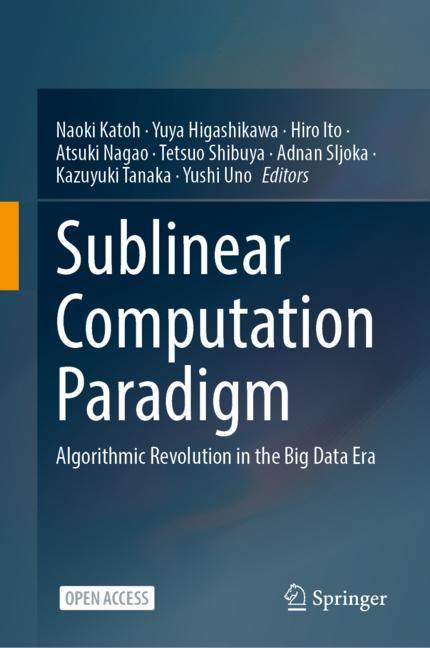
Sublinear Computation Paradigm
☆☆☆☆☆
(0 reviews)
| Vânzător | Product price | Delivery | Total | Disponibilitate | Updated | |
|---|---|---|---|---|---|---|
| SP SpringerNatureLink Shop INT | 66,68 EUR | free | 66,68 EUR | Disponibil | 3 zile în urmă | View offer |
| SP Springer Nature Author | 66,68 EUR | free | 66,68 EUR | Disponibil | 1 săptămână în urmă | View offer |
Prețurile și disponibilitatea se pot modifica. Ultima actualizare: 08.08.2026 21:11.
EAN
9789811640940
Springer Nature
0,0
☆☆☆☆☆
0 reviews
5★
0%
4★
0%
3★
0%
2★
0%
1★
0%
Product reviews
No reviews yet — be the first!
This open access book gives an overview of cutting-edge work on a new paradigm called the “sublinear computation paradigm,” which was proposed in the large multiyear academic research project “Foundations of Innovative Algorithms for Big Data.” That project ran from October 2014 to March 2020, in Japan. To handle the unprecedented explosion of big data sets in research, industry, and other areas of society, there is an urgent need to develop novel methods and approaches for big data analysis. To meet this need, innovative changes in algorithm theory for big data are being pursued. For example, polynomial-time algorithms have thus far been regarded as “fast,” but if a quadratic-time algorithm is applied to a petabyte-scale or larger big data set, problems are encountered in terms of computational resources or running time. To deal with this critical computational and algorithmic bottleneck, linear, sublinear, and constant time algorithms are required. The sublinear computation paradigm is proposed here in order to support innovation in the big data era. A foundation of innovative algorithms has been created by developing computational procedures, data structures, and modelling techniques for big data. The project is organized into three teams that focus on sublinear algorithms, sublinear data structures, and sublinear modelling. The work has provided high-level academic research results of strong computational and algorithmic interest, which are presented in this book. The book consists of five parts: Part I, which consists of a single chapter on the concept of the sublinear computation paradigm; Parts II, III, and IV review results on sublinear algorithms, sublinear data structures, and sublinear modelling, respectively; Part V presents application results. The information presented here will inspire the researchers who work in the field of modern algorithms.
Similar products
 50 Years of Philosophy and Medicine
from $107.30
50 Years of Philosophy and Medicine
from $107.30
 Understanding Cybersecurity Law and Digital Privacy
from $122.63
Understanding Cybersecurity Law and Digital Privacy
from $122.63
 Decisions in International Trade and Logistics
from $122.63
Decisions in International Trade and Logistics
from $122.63
 Advances in Economic Measurement
from $122.63
Advances in Economic Measurement
from $122.63
 Nanomaterials
from $137.96
Nanomaterials
from $137.96
 Sustainable Scaffolds-based Strategies in Tissue Engineering and Regenerative Medicine
from $162.87
Sustainable Scaffolds-based Strategies in Tissue Engineering and Regenerative Medicine
from $162.87
 Narratives in Educational Research
from $162.87
Narratives in Educational Research
from $162.87
 Environmental Biology of the Young Chinese Sturgeon
from $210.78
Environmental Biology of the Young Chinese Sturgeon
from $210.78