
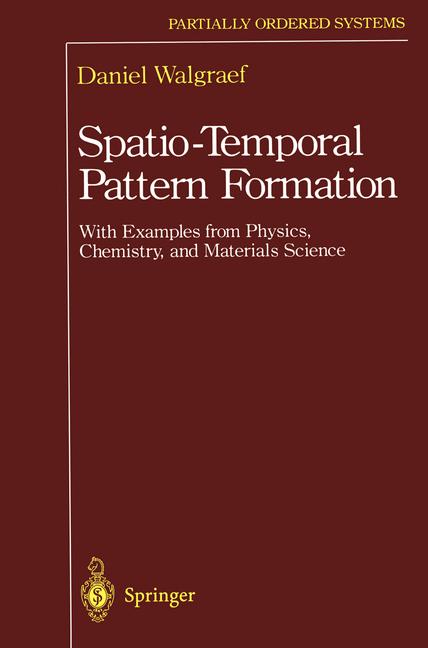
Spatio-Temporal Pattern Formation
☆☆☆☆☆
(0 reviews)
Lowest price (incl. delivery)
7 164,00 JPY
Typical price348,98 PLN
Lowest (90 days)44,99 PLN
Offers2
Last updated1 zi în urmă
| Vânzător | Product price | Delivery | Total | Disponibilitate | Updated | |
|---|---|---|---|---|---|---|
| SP Springer Nature Author | 7 149,00 JPY | 15,00 JPY | 7 164,00 JPY | Disponibil | 1 zi în urmă | View offer |
| SP SpringerNatureLink Shop INT | 59,00 EUR | 15,00 EUR | 74,00 EUR | Disponibil | 1 zi în urmă | View offer |
Prețurile și disponibilitatea se pot modifica. Ultima actualizare: 08.08.2026 23:11.
0,0
☆☆☆☆☆
0 reviews
5★
0%
4★
0%
3★
0%
2★
0%
1★
0%
Product reviews
No reviews yet — be the first!
Spatio-temporal patterns appear almost everywhere in nature, and their description and understanding still raise important and basic questions. However, if one looks back 20 or 30 years, definite progress has been made in the modeling of insta bilities, analysis of the dynamics in their vicinity, pattern formation and stability, quantitative experimental and numerical analysis of patterns, and so on. Universal behaviors of complex systems close to instabilities have been determined, leading to the wide interdisciplinarity of a field that is now referred to as nonlinear science or science of complexity, and in which initial concepts of dissipative structures or synergetics are deeply rooted. In pioneering domains related to hydrodynamics or chemical instabilities, the interactions between experimentalists and theoreticians, sometimes on a daily basis, have been a key to progress. Everyone in the field praises the role played by the interactions and permanent feedbacks between ex perimental, numerical, and analytical studies in the achievements obtained during these years. Many aspects of convective patterns in normal fluids, binary mixtures or liquid crystals are now understood and described in this framework. The generic pres ence of defects in extended systems is now well established and has induced new developments in the physics of laser with large Fresnel numbers. Last but not least, almost 40 years after his celebrated paper, Turing structures have finally been ob tained in real-life chemical reactors, triggering anew intense activity in the field of reaction-diffusion systems.
Similar products
 Patient Safety Coaching
from $91.97
Patient Safety Coaching
from $91.97
 Ethnography and Diversity
from $69.30
Ethnography and Diversity
from $69.30
 Smart Villages
from $91.97
Smart Villages
from $91.97
 Nuclear Non-Proliferation in International Law - Volume VI
from $91.97
Nuclear Non-Proliferation in International Law - Volume VI
from $91.97
 The Price of Freedom
from $91.97
The Price of Freedom
from $91.97
 Eco-Social Policy in the OECD and the World Bank
from $91.97
Eco-Social Policy in the OECD and the World Bank
from $91.97
 Special Topics in Policing
from $122.58
Special Topics in Policing
from $122.58
 Music from the Heart
from $91.97
Music from the Heart
from $91.97