
Space Plasma Simulation
☆☆☆☆☆
(0 reviews)
Lowest price (incl. delivery)
22 894,00 JPY
Typical price4 115,61 PLN
Lowest (90 days)139,99 PLN
Offers6
Last updated1 săptămână în urmă
Price history (90 days)
Full history
2026-08-08
2026-08-15
| Actualizat la | Preț |
|---|---|
| 2026-08-08 | 139,99 |
| 2026-08-15 | 166,39 |
| Vânzător | Product price | Delivery | Total | Disponibilitate | Updated | |
|---|---|---|---|---|---|---|
| SP SpringerNatureLink Shop INT | 22 879,00 JPY | 15,00 JPY | 22 894,00 JPY | Disponibil | 2 zile în urmă | View offer |
| SP Springer Nature Author | 22 879,00 JPY | free | 22 879,00 JPY | Disponibil | 1 săptămână în urmă | View offer |
| SP SpringerNatureLink Shop INT | 159,99 USD | 29,00 USD | 188,99 USD | Disponibil | 2 zile în urmă | View offer |
| SP SpringerNatureLink Shop INT | 179,99 USD | free | 179,99 USD | Disponibil | 2 zile în urmă | View offer |
| SP SpringerNatureLink Shop INT | 179,99 USD | free | 179,99 USD | Disponibil | 2 zile în urmă | View offer |
| SP SpringerNatureLink Shop INT | 189,00 EUR | free | 189,00 EUR | Disponibil | 2 zile în urmă | View offer |
Prețurile și disponibilitatea se pot modifica. Ultima actualizare: 08.08.2026 23:36.
0,0
☆☆☆☆☆
0 reviews
5★
0%
4★
0%
3★
0%
2★
0%
1★
0%
Product reviews
No reviews yet — be the first!
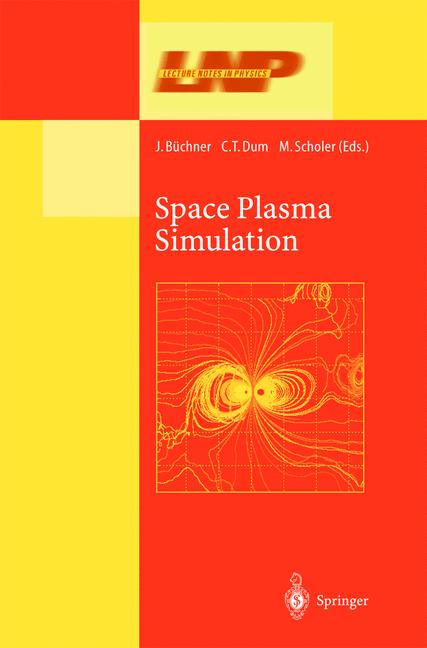
The aim of this book is twofold: to provide an introduction for newcomers to state of the art computer simulation techniques in space plasma physics and an overview of current developments. Computer simulation has reached a stage where it can be a highly useful tool for guiding theory and for making predictions of space plasma phenomena, ranging from microscopic to global scales. The various articles are arranged, as much as possible, according to the - derlying simulation technique, starting with the technique that makes the least number of assumptions: a fully kinetic approach which solves the coupled set of Maxwell’s equations for the electromagnetic ?eld and the equations of motion for a very large number of charged particles (electrons and ions) in this ?eld. Clearly, this is also the computationally most demanding model. Therefore, even with present day high performance computers, it is the most restrictive in terms of the space and time domain and the range of particle parameters that can be covered by the simulation experiments. It still makes sense, therefore, to also use models, which due to their simp- fying assumptions, seem less realistic, although the e?ect of these assumptions on the outcome of the simulation experiments needs to be carefully assessed.
Similar products
 50 Years of Philosophy and Medicine
from $107.30
50 Years of Philosophy and Medicine
from $107.30
 Understanding Cybersecurity Law and Digital Privacy
from $122.63
Understanding Cybersecurity Law and Digital Privacy
from $122.63
 Decisions in International Trade and Logistics
from $122.63
Decisions in International Trade and Logistics
from $122.63
 Advances in Economic Measurement
from $122.63
Advances in Economic Measurement
from $122.63
 Nanomaterials
from $137.96
Nanomaterials
from $137.96
 Sustainable Scaffolds-based Strategies in Tissue Engineering and Regenerative Medicine
from $162.87
Sustainable Scaffolds-based Strategies in Tissue Engineering and Regenerative Medicine
from $162.87
 Narratives in Educational Research
from $162.87
Narratives in Educational Research
from $162.87
 Environmental Biology of the Young Chinese Sturgeon
from $210.78
Environmental Biology of the Young Chinese Sturgeon
from $210.78