
Scientific Machine Learning
☆☆☆☆☆
(0 reviews)
Lowest price (incl. delivery)
25 186,00 JPY
Typical price12 687,50 PLN
Lowest (90 days)208,00 PLN
Offers3
Last updated45 minute în urmă
Price history (90 days)
Full history
2026-08-08
2026-08-15
| Actualizat la | Preț |
|---|---|
| 2026-08-08 | 25 167,00 |
| 2026-08-15 | 208,00 |
| Vânzător | Product price | Delivery | Total | Disponibilitate | Updated | |
|---|---|---|---|---|---|---|
| SP Springer Nature Author | 25 167,00 JPY | 19,00 JPY | 25 186,00 JPY | Disponibil | 6 zile în urmă | View offer |
| SP SpringerNatureLink Shop INT | 199,00 USD | 19,00 USD | 218,00 USD | Disponibil | 56 minute în urmă | View offer |
| SP SpringerNatureLink Shop INT | 208,00 EUR | 15,00 EUR | 223,00 EUR | Disponibil | 45 minute în urmă | View offer |
Prețurile și disponibilitatea se pot modifica. Ultima actualizare: 15.08.2026 06:57.
EAN
9783032115270
Springer Nature
0,0
☆☆☆☆☆
0 reviews
5★
0%
4★
0%
3★
0%
2★
0%
1★
0%
Product reviews
No reviews yet — be the first!
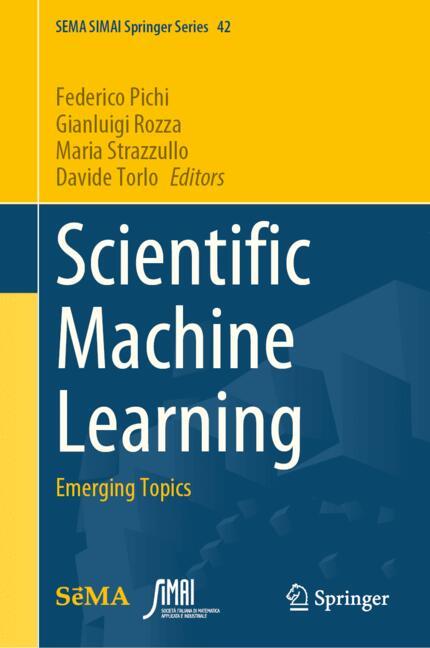
This volume gathers peer-reviewed papers from the workshop Scientific Machine Learning: Emerging Topics, held at SISSA in Trieste, Italy. The event gathered leading researchers in mathematics, algorithms, and machine learning. Its goal was to advance the synergy between data-driven models and scientific computing, promoting robust, interpretable, and scalable methods. The works reflect major trends in scientific machine learning (SciML), including optimization, physics-informed learning, neural graph/operators/ODE, transformers, and generative models. Contributions propose physics-based constrained neural networks, advancements in optimization and model reduction, and applications across power systems, chemical kinetics, and biomechanics. Topics span from hybrid models for image classification to generative compression and neural operators for high-dimensional systems. Blending theory and practice, the volume captures the diversity and innovation shaping modern SciML. This volume is addressed to researchers and will provide readers with insight into the current state of the field, sparks new ideas, and encourages further research at the rich intersection of machine learning, mathematics, and scientific computing.
Similar products
 Assessing, Explaining, and Rating AI Systems for Trust
from $30.65
Assessing, Explaining, and Rating AI Systems for Trust
from $30.65
 Digital Health Technologies and the Menopause
from $30.65
Digital Health Technologies and the Menopause
from $30.65
 Preparing College Faculty for Equitable Assessment
from $30.65
Preparing College Faculty for Equitable Assessment
from $30.65
 Managing Information Singularity
from $30.65
Managing Information Singularity
from $30.65
 Ingenious Principles of Nature
from $30.65
Ingenious Principles of Nature
from $30.65
 Reconceptualizing Exiting and Career Development in Sex Work
from $30.65
Reconceptualizing Exiting and Career Development in Sex Work
from $30.65
 Learning on the Margins
from $30.65
Learning on the Margins
from $30.65
 Jewish American Parents Navigating Autism Supports
from $30.65
Jewish American Parents Navigating Autism Supports
from $30.65