
Scientific Data Analysis
☆☆☆☆☆
(0 reviews)
Lowest price (incl. delivery)
7 168,00 JPY
Typical price390,27 PLN
Lowest (90 days)44,99 PLN
Offers6
Last updated1 săptămână în urmă
Price history (90 days)
Full history
2026-08-08
2026-08-15
| Actualizat la | Preț |
|---|---|
| 2026-08-08 | 49,99 |
| 2026-08-14 | 44,99 |
| 2026-08-15 | 51,99 |
| Vânzător | Product price | Delivery | Total | Disponibilitate | Updated | |
|---|---|---|---|---|---|---|
| SP SpringerNatureLink Shop INT | 7 149,00 JPY | 19,00 JPY | 7 168,00 JPY | Disponibil | 1 zi în urmă | View offer |
| SP Springer Nature Author | 7 149,00 JPY | free | 7 149,00 JPY | Disponibil | 1 săptămână în urmă | View offer |
| SP SpringerNatureLink Shop INT | 49,99 USD | 25,00 USD | 74,99 USD | Disponibil | 1 zi în urmă | View offer |
| SP SpringerNatureLink Shop INT | 54,99 USD | 15,00 USD | 69,99 USD | Disponibil | 1 zi în urmă | View offer |
| SP SpringerNatureLink Shop INT | 54,99 USD | 19,00 USD | 73,99 USD | Disponibil | 1 zi în urmă | View offer |
| SP SpringerNatureLink Shop INT | 59,00 EUR | free | 59,00 EUR | Disponibil | 1 zi în urmă | View offer |
Prețurile și disponibilitatea se pot modifica. Ultima actualizare: 08.08.2026 23:12.
0,0
☆☆☆☆☆
0 reviews
5★
0%
4★
0%
3★
0%
2★
0%
1★
0%
Product reviews
No reviews yet — be the first!
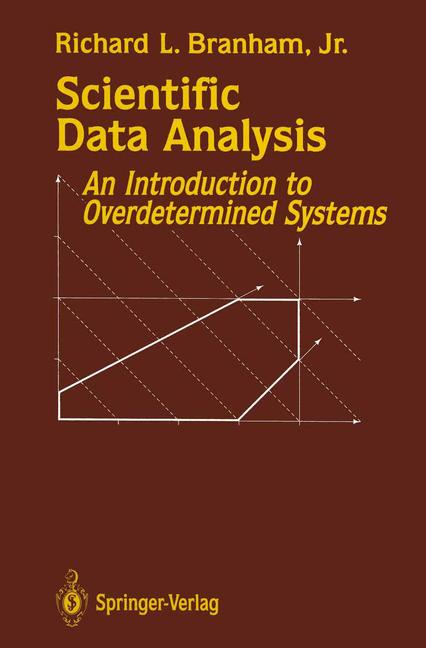
This monograph is concerned with overdetermined systems, inconsistent systems with more equations than unknowns, in scientific data reduction. It is not a text on statistics, numerical methods, or matrix cOmputations, although elements of all three, especially the latter, enter into the discussion. The reader I have in mind is a scientist or engineer who has gathered data that he or she wants to model by a mathematical system, perhaps linear, perhaps nonlinear, and solve to obtain the best estimates, in some sense of the term "best," of various parameters. Because the calculations will be performed on a digital computer, the first chapter discusses floating-point numbers and their effect on mathematical operations. The chapter ends with some methods for accurately summing floating-point numbers, an operation frequently required in numerical work and one often done by the worst possible method, recursive summation. Chapter 2 gives a brief review of linear algebra and includes vector and matrix norms and condition numbers of matrices and linear systems. ' Chapter 3 presents some ideas for manipulating sparse matrices. Frequently, time or memory can be saved by use of sparse matrix techniques. The subject is extensive and the chapter is only indicative of the many techniques available. Although Chapter 3 is somewhat extraneous to the rest of the book, Chapter 5, on linear least squares, makes use of the compressed storage mode for the symmetric matrices discussed in Chapter 3.
Similar products
 50 Years of Philosophy and Medicine
from $107.30
50 Years of Philosophy and Medicine
from $107.30
 Understanding Cybersecurity Law and Digital Privacy
from $122.63
Understanding Cybersecurity Law and Digital Privacy
from $122.63
 Decisions in International Trade and Logistics
from $122.63
Decisions in International Trade and Logistics
from $122.63
 Advances in Economic Measurement
from $122.63
Advances in Economic Measurement
from $122.63
 Nanomaterials
from $137.96
Nanomaterials
from $137.96
 Sustainable Scaffolds-based Strategies in Tissue Engineering and Regenerative Medicine
from $162.87
Sustainable Scaffolds-based Strategies in Tissue Engineering and Regenerative Medicine
from $162.87
 Narratives in Educational Research
from $162.87
Narratives in Educational Research
from $162.87
 Environmental Biology of the Young Chinese Sturgeon
from $210.78
Environmental Biology of the Young Chinese Sturgeon
from $210.78