
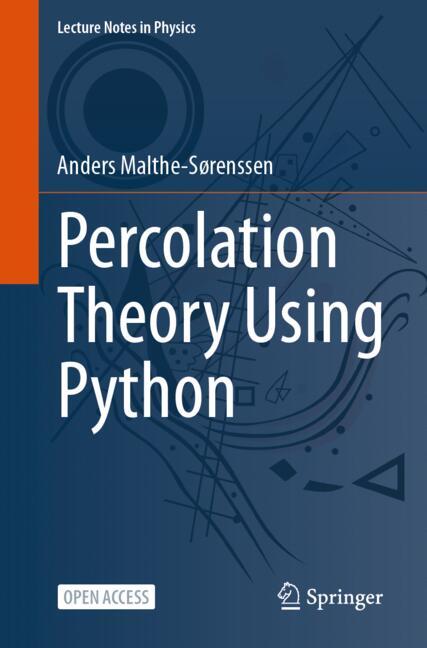
Percolation Theory Using Python
☆☆☆☆☆
(0 reviews)
Lowest price (incl. delivery)
76,19 EUR
Typical price45,39 PLN
Lowest (90 days)43,59 PLN
Offers2
Last updated4 zile în urmă
| Vânzător | Product price | Delivery | Total | Disponibilitate | Updated | |
|---|---|---|---|---|---|---|
| SP SpringerNatureLink Shop INT | 47,19 EUR | 29,00 EUR | 76,19 EUR | Disponibil | 4 zile în urmă | View offer |
| SP Springer Nature Author | 47,19 EUR | 25,00 EUR | 72,19 EUR | Disponibil | 3 zile în urmă | View offer |
Prețurile și disponibilitatea se pot modifica. Ultima actualizare: 08.08.2026 09:13.
EAN
9783031598999
Springer Nature
0,0
☆☆☆☆☆
0 reviews
5★
0%
4★
0%
3★
0%
2★
0%
1★
0%
Product reviews
No reviews yet — be the first!
This course-based open access textbook delves into percolation theory, examining the physical properties of random media—materials characterized by varying sizes of holes and pores. The focus is on both the mathematical foundations and the computational and statistical methods used in this field. Designed as a practical introduction, the book places particular emphasis on providing a comprehensive set of computational tools necessary for studying percolation theory. Readers will learn how to generate, analyze, and comprehend data and models, with detailed theoretical discussions complemented by accessible computer codes. The book's structure ensures a complete exploration of worked examples, encompassing theory, modeling, implementation, analysis, and the resulting connections between theory and analysis. Beginning with a simplified model system—a model porous medium—whose mathematical theory is well-established, the book subsequently applies the same framework to realistic random systems. Key topics covered include one- and infinite-dimensional percolation, clusters, scaling theory, diffusion in disordered media, and dynamic processes. Aimed at graduate students and researchers, this textbook serves as a foundational resource for understanding essential concepts in modern statistical physics, such as disorder, scaling, and fractal geometry.
Similar products
 Patient Safety Coaching
from $91.97
Patient Safety Coaching
from $91.97
 Ethnography and Diversity
from $69.30
Ethnography and Diversity
from $69.30
 Smart Villages
from $91.97
Smart Villages
from $91.97
 Nuclear Non-Proliferation in International Law - Volume VI
from $91.97
Nuclear Non-Proliferation in International Law - Volume VI
from $91.97
 The Price of Freedom
from $91.97
The Price of Freedom
from $91.97
 Eco-Social Policy in the OECD and the World Bank
from $91.97
Eco-Social Policy in the OECD and the World Bank
from $91.97
 Special Topics in Policing
from $122.58
Special Topics in Policing
from $122.58
 Music from the Heart
from $91.97
Music from the Heart
from $91.97