
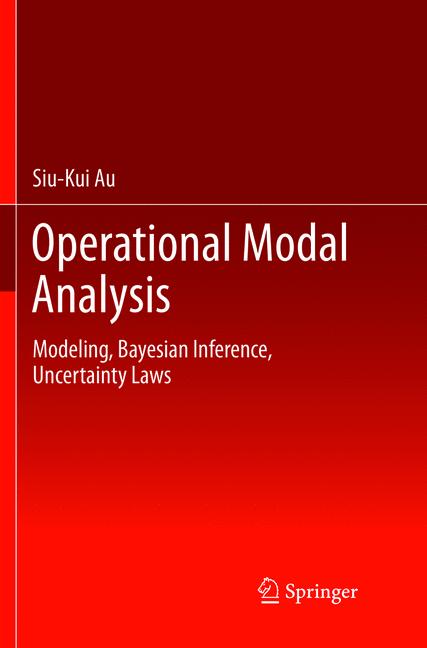
Operational Modal Analysis
☆☆☆☆☆
(0 reviews)
Lowest price (incl. delivery)
314,99 USD
Typical price289,99 PLN
Lowest (90 days)249,99 PLN
Offers7
Last updated5 zile în urmă
Price history (90 days)
Full history
2026-08-08
2026-08-15
| Actualizat la | Preț |
|---|---|
| 2026-08-08 | 249,99 |
| 2026-08-15 | 329,99 |
| Vânzător | Product price | Delivery | Total | Disponibilitate | Updated | |
|---|---|---|---|---|---|---|
| SP SpringerNatureLink Shop INT | 299,99 USD | 15,00 USD | 314,99 USD | Disponibil | 5 zile în urmă | View offer |
| SP SpringerNatureLink Shop INT | 299,99 USD | free | 299,99 USD | Disponibil | 5 zile în urmă | View offer |
| SP Springer Nature Author | 249,99 GBP | 29,00 GBP | 278,99 GBP | Disponibil | 1 săptămână în urmă | View offer |
| SP SpringerNatureLink Shop INT | 329,99 USD | free | 329,99 USD | Disponibil | 5 zile în urmă | View offer |
| SP SpringerNatureLink Shop INT | 329,99 USD | 19,00 USD | 348,99 USD | Disponibil | 5 zile în urmă | View offer |
| SP SpringerNatureLink Shop INT | 329,99 USD | 29,00 USD | 358,99 USD | Disponibil | 5 zile în urmă | View offer |
| SP SpringerNatureLink Shop INT | 329,99 EUR | 19,00 EUR | 348,99 EUR | Disponibil | 5 zile în urmă | View offer |
Prețurile și disponibilitatea se pot modifica. Ultima actualizare: 15.08.2026 07:34.
0,0
☆☆☆☆☆
0 reviews
5★
0%
4★
0%
3★
0%
2★
0%
1★
0%
Product reviews
No reviews yet — be the first!
This book presents operational modal analysis (OMA), employing a coherent and comprehensive Bayesian framework for modal identification and covering stochastic modeling, theoretical formulations, computational algorithms, and practical applications. Mathematical similarities and philosophical differences between Bayesian and classical statistical approaches to system identification are discussed, allowing their mathematical tools to be shared and their results correctly interpreted. The authors provide their data freely in the web at https://doi.org/10.7910/DVN/7EVTXG Many chapters can be used as lecture notes for the general topic they cover beyond the OMA context. After an introductory chapter (1), Chapters 2–7 present the general theory of stochastic modeling and analysis of ambient vibrations. Readers are first introduced to the spectral analysis of deterministic time series (2) and structural dynamics (3),which do not require the use of probability concepts. The concepts and techniques in these chapters are subsequently extended to a probabilistic context in Chapter 4 (on stochastic processes) and in Chapter 5 (on stochastic structural dynamics). In turn, Chapter 6 introduces the basics of ambient vibration instrumentation and data characteristics, while Chapter 7 discusses the analysis and simulation of OMA data, covering different types of data encountered in practice. Bayesian and classical statistical approaches to system identification are introduced in a general context in Chapters 8 and 9, respectively. Chapter 10 provides an overview of different Bayesian OMA formulations, followed by a general discussion of computational issues in Chapter 11. Efficient algorithms for different contexts are discussed in Chapters 12–14 (single mode, multi-mode, and multi-setup). Intended for readers with a minimal background in mathematics, Chapter 15 presents the ‘uncertainty laws’ in OMA, one of the latest advances that establish the achievable precision limit of OMA and provide a scientific basis for planning ambient vibration tests. Lastly Chapter 16 discusses the mathematical theory behind the results in Chapter 15, addressing the needs of researchers interested in learning the techniques for further development. Three appendix chapters round out the coverage. This book is primarily intended for graduate/senior undergraduate students and researchers, although practitioners will also find the book a useful reference guide. It covers materials from introductory to advanced level, which are classified accordingly to ensure easy access. Readers with an undergraduate-level background in probability and statistics will find the book an invaluable resource, regardless of whether they are Bayesian or non-Bayesian.
Similar products
 Gamma Knife Neurosurgery in the Management of Intracranial Disorders
from $210.78
Gamma Knife Neurosurgery in the Management of Intracranial Disorders
from $210.78
 SDGs in Construction Economics and Organization
from $210.78
SDGs in Construction Economics and Organization
from $210.78
 Emerging Therapies in Neurorehabilitation III
from $210.78
Emerging Therapies in Neurorehabilitation III
from $210.78
 Ground Improvement Techniques
from $220.36
Ground Improvement Techniques
from $220.36
 Anomaly Detection in Video Surveillance
from $220.36
Anomaly Detection in Video Surveillance
from $220.36
 Mechanism and Machine Science
from $287.42
Mechanism and Machine Science
from $287.42
 Protein-Protein Interactions as New Drug Targets
from $287.42
Protein-Protein Interactions as New Drug Targets
from $287.42
 Proceedings of the 7th International Conference of Transportation Research Group of India (CTRG 2023
from $287.42
Proceedings of the 7th International Conference of Transportation Research Group of India (CTRG 2023
from $287.42