
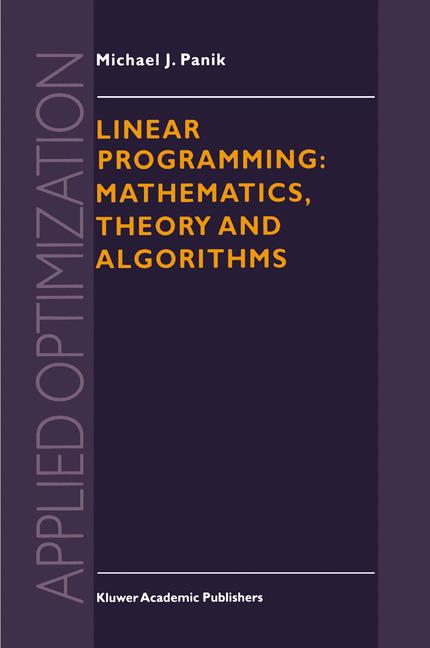
Linear Programming: Mathematics, Theory and Algorithms
☆☆☆☆☆
(0 reviews)
Lowest price (incl. delivery)
28 599,00 JPY
Typical price5 060,63 PLN
Lowest (90 days)210,99 PLN
Offers6
Last updated3 zile în urmă
Price history (90 days)
Full history
2026-08-08
2026-08-15
| Actualizat la | Preț |
|---|---|
| 2026-08-08 | 213,99 |
| 2026-08-15 | 210,99 |
| Vânzător | Product price | Delivery | Total | Disponibilitate | Updated | |
|---|---|---|---|---|---|---|
| SP SpringerNatureLink Shop INT | 28 599,00 JPY | free | 28 599,00 JPY | Disponibil | 3 zile în urmă | View offer |
| SP Springer Nature Author | 28 599,00 JPY | 29,00 JPY | 28 628,00 JPY | Disponibil | 1 săptămână în urmă | View offer |
| SP SpringerNatureLink Shop INT | 219,00 USD | 29,00 USD | 248,00 USD | Disponibil | 3 zile în urmă | View offer |
| SP SpringerNatureLink Shop INT | 219,00 USD | 15,00 USD | 234,00 USD | Disponibil | 3 zile în urmă | View offer |
| SP SpringerNatureLink Shop INT | 219,99 USD | 29,00 USD | 248,99 USD | Disponibil | 3 zile în urmă | View offer |
| SP SpringerNatureLink Shop INT | 241,99 EUR | free | 241,99 EUR | Disponibil | 3 zile în urmă | View offer |
Prețurile și disponibilitatea se pot modifica. Ultima actualizare: 15.08.2026 07:17.
0,0
☆☆☆☆☆
0 reviews
5★
0%
4★
0%
3★
0%
2★
0%
1★
0%
Product reviews
No reviews yet — be the first!
Linear Programming provides an in-depth look at simplex based as well as the more recent interior point techniques for solving linear programming problems. Starting with a review of the mathematical underpinnings of these approaches, the text provides details of the primal and dual simplex methods with the primal-dual, composite, and steepest edge simplex algorithms. This then is followed by a discussion of interior point techniques, including projective and affine potential reduction, primal and dual affine scaling, and path following algorithms. Also covered is the theory and solution of the linear complementarity problem using both the complementary pivot algorithm and interior point routines. A feature of the book is its early and extensive development and use of duality theory. Audience: The book is written for students in the areas of mathematics, economics, engineering and management science, and professionals who need a sound foundation in the important and dynamic discipline of linear programming.
Similar products
 50 Years of Philosophy and Medicine
from $107.30
50 Years of Philosophy and Medicine
from $107.30
 Understanding Cybersecurity Law and Digital Privacy
from $122.63
Understanding Cybersecurity Law and Digital Privacy
from $122.63
 Decisions in International Trade and Logistics
from $122.63
Decisions in International Trade and Logistics
from $122.63
 Advances in Economic Measurement
from $122.63
Advances in Economic Measurement
from $122.63
 Nanomaterials
from $137.96
Nanomaterials
from $137.96
 Sustainable Scaffolds-based Strategies in Tissue Engineering and Regenerative Medicine
from $162.87
Sustainable Scaffolds-based Strategies in Tissue Engineering and Regenerative Medicine
from $162.87
 Narratives in Educational Research
from $162.87
Narratives in Educational Research
from $162.87
 Environmental Biology of the Young Chinese Sturgeon
from $210.78
Environmental Biology of the Young Chinese Sturgeon
from $210.78