
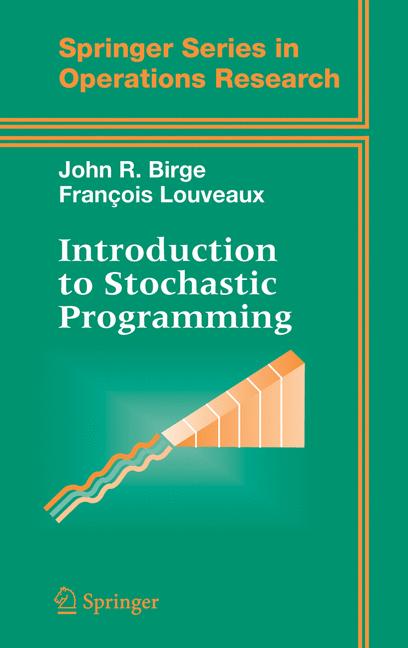
Introduction to Stochastic Programming
☆☆☆☆☆
(0 reviews)
Lowest price (incl. delivery)
9 180,00 JPY
Typical price1 591,33 PLN
Lowest (90 days)56,99 PLN
Offers3
Last updated1 săptămână în urmă
Price history (90 days)
Full history
2026-08-08
2026-08-15
| Actualizat la | Preț |
|---|---|
| 2026-08-08 | 56,99 |
| 2026-08-15 | 85,00 |
| Vânzător | Product price | Delivery | Total | Disponibilitate | Updated | |
|---|---|---|---|---|---|---|
| SP SpringerNatureLink Shop INT | 9 151,00 JPY | 29,00 JPY | 9 180,00 JPY | Disponibil | 6 zile în urmă | View offer |
| SP Springer Nature Author | 9 151,00 JPY | 19,00 JPY | 9 170,00 JPY | Disponibil | 1 săptămână în urmă | View offer |
| SP SpringerNatureLink Shop INT | 85,00 EUR | 29,00 EUR | 114,00 EUR | Disponibil | 6 zile în urmă | View offer |
Prețurile și disponibilitatea se pot modifica. Ultima actualizare: 08.08.2026 23:18.
EAN
9780387226187
Springer Nature
0,0
☆☆☆☆☆
0 reviews
5★
0%
4★
0%
3★
0%
2★
0%
1★
0%
Product reviews
No reviews yet — be the first!
The aim of stochastic programming is to find optimal decisions in problems which involve uncertain data. This field is currently developing rapidly with contributions from many disciplines including operations research, mathematics, and probability. Conversely, it is being applied in a wide variety of subjects ranging from agriculture to financial planning and from industrial engineering to computer networks. This textbook provides a first course in stochastic programming suitable for students with a basic knowledge of linear programming, elementary analysis, and probability. The authors aim to present a broad overview of the main themes and methods of the subject. Its prime goal is to help students develop an intuition on how to model uncertainty into mathematical problems, what uncertainty changes bring to the decision process, and what techniques help to manage uncertainty in solving the problems. The first chapters introduce some worked examples of stochastic programming and demonstrate how a stochastic model is formally built. Subsequent chapters develop the properties of stochastic programs and the basic solution techniques used to solve them. Three chapters cover approximation and sampling techniques and the final chapter presents a case study in depth. A wide range of students from operations research, industrial engineering, and related disciplines will find this a well-paced and wide-ranging introduction to this subject.
Similar products
 50 Years of Philosophy and Medicine
from $107.30
50 Years of Philosophy and Medicine
from $107.30
 Understanding Cybersecurity Law and Digital Privacy
from $122.63
Understanding Cybersecurity Law and Digital Privacy
from $122.63
 Decisions in International Trade and Logistics
from $122.63
Decisions in International Trade and Logistics
from $122.63
 Advances in Economic Measurement
from $122.63
Advances in Economic Measurement
from $122.63
 Nanomaterials
from $137.96
Nanomaterials
from $137.96
 Sustainable Scaffolds-based Strategies in Tissue Engineering and Regenerative Medicine
from $162.87
Sustainable Scaffolds-based Strategies in Tissue Engineering and Regenerative Medicine
from $162.87
 Narratives in Educational Research
from $162.87
Narratives in Educational Research
from $162.87
 Environmental Biology of the Young Chinese Sturgeon
from $210.78
Environmental Biology of the Young Chinese Sturgeon
from $210.78