
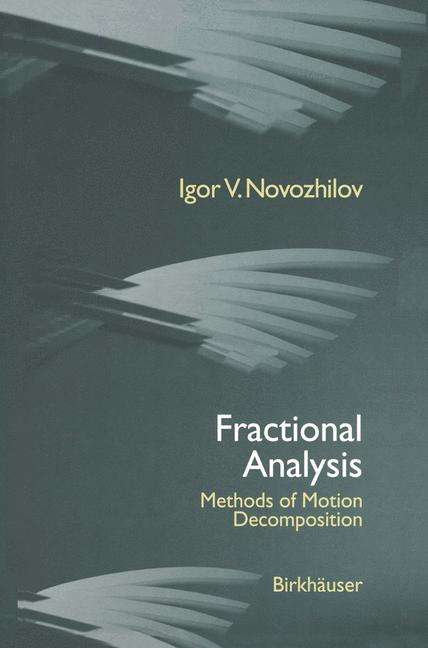
Fractional Analysis
☆☆☆☆☆
(0 reviews)
Lowest price (incl. delivery)
7 149,00 JPY
Typical price544,92 PLN
Lowest (90 days)44,99 PLN
Offers7
Last updated1 săptămână în urmă
Price history (90 days)
Full history
2026-08-08
2026-08-15
| Actualizat la | Preț |
|---|---|
| 2026-08-08 | 44,99 |
| 2026-08-14 | 44,99 |
| 2026-08-15 | 52,74 |
| Vânzător | Product price | Delivery | Total | Disponibilitate | Updated | |
|---|---|---|---|---|---|---|
| SP SpringerNatureLink Shop INT | 7 149,00 JPY | free | 7 149,00 JPY | Disponibil | 5 zile în urmă | View offer |
| SP Springer Nature Author | 7 149,00 JPY | 15,00 JPY | 7 164,00 JPY | Disponibil | 1 săptămână în urmă | View offer |
| SP SpringerNatureLink Shop INT | 49,99 USD | 19,00 USD | 68,99 USD | Disponibil | 5 zile în urmă | View offer |
| SP SpringerNatureLink Shop INT | 49,99 USD | 25,00 USD | 74,99 USD | Disponibil | 5 zile în urmă | View offer |
| SP SpringerNatureLink Shop INT | 54,99 USD | free | 54,99 USD | Disponibil | 5 zile în urmă | View offer |
| SP SpringerNatureLink Shop INT | 54,99 USD | free | 54,99 USD | Disponibil | 5 zile în urmă | View offer |
| SP SpringerNatureLink Shop INT | 59,00 EUR | free | 59,00 EUR | Disponibil | 5 zile în urmă | View offer |
Prețurile și disponibilitatea se pot modifica. Ultima actualizare: 08.08.2026 23:11.
0,0
☆☆☆☆☆
0 reviews
5★
0%
4★
0%
3★
0%
2★
0%
1★
0%
Product reviews
No reviews yet — be the first!
This book considers methods of approximate analysis of mechanical, elec tromechanical, and other systems described by ordinary differential equa tions. Modern mathematical modeling of sophisticated mechanical systems consists of several stages: first, construction of a mechanical model, and then writing appropriate equations and their analytical or numerical ex amination. Usually, this procedure is repeated several times. Even if an initial model correctly reflects the main properties of a phenomenon, it de scribes, as a rule, many unnecessary details that make equations of motion too complicated. As experience and experimental data are accumulated, the researcher considers simpler models and simplifies the equations. Thus some terms are discarded, the order of the equations is lowered, and so on. This process requires time, experimentation, and the researcher's intu ition. A good example of such a semi-experimental way of simplifying is a gyroscopic precession equation. Formal mathematical proofs of its admis sibility appeared some several decades after its successful introduction in engineering calculations. Applied mathematics now has at its disposal many methods of approxi mate analysis of differential equations. Application of these methods could shorten and formalize the procedure of simplifying the equations and, thus, of constructing approximate motion models. Wide application of the methods into practice is hindered by the fol lowing. 1. Descriptions of various approximate methods are scattered over the mathematical literature. The researcher, as a rule, does not know what method is most suitable for a specific case. 2.
Similar products
 50 Years of Philosophy and Medicine
from $107.30
50 Years of Philosophy and Medicine
from $107.30
 Understanding Cybersecurity Law and Digital Privacy
from $122.63
Understanding Cybersecurity Law and Digital Privacy
from $122.63
 Decisions in International Trade and Logistics
from $122.63
Decisions in International Trade and Logistics
from $122.63
 Advances in Economic Measurement
from $122.63
Advances in Economic Measurement
from $122.63
 Nanomaterials
from $137.96
Nanomaterials
from $137.96
 Sustainable Scaffolds-based Strategies in Tissue Engineering and Regenerative Medicine
from $162.87
Sustainable Scaffolds-based Strategies in Tissue Engineering and Regenerative Medicine
from $162.87
 Narratives in Educational Research
from $162.87
Narratives in Educational Research
from $162.87
 Environmental Biology of the Young Chinese Sturgeon
from $210.78
Environmental Biology of the Young Chinese Sturgeon
from $210.78