
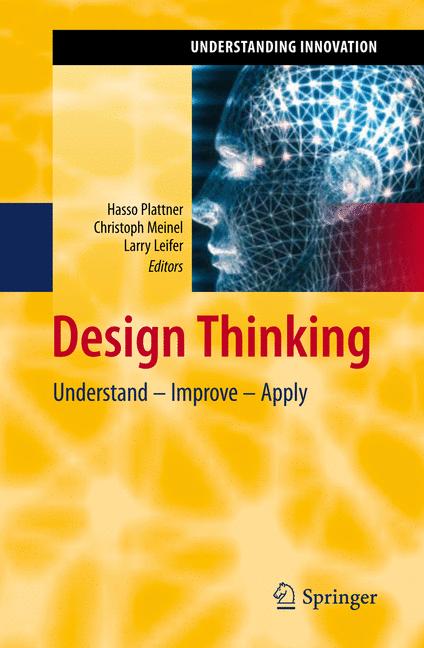
Design Thinking
☆☆☆☆☆
(0 reviews)
Lowest price (incl. delivery)
154,00 GBP
Typical price208,00 PLN
Lowest (90 days)208,00 PLN
Offers2
Last updated2 zile în urmă
| Vânzător | Product price | Delivery | Total | Disponibilitate | Updated | |
|---|---|---|---|---|---|---|
| SP Springer Nature Author | 154,00 GBP | free | 154,00 GBP | Disponibil | 1 săptămână în urmă | View offer |
| SP SpringerNatureLink Shop INT | 208,00 EUR | 25,00 EUR | 233,00 EUR | Disponibil | 2 zile în urmă | View offer |
Prețurile și disponibilitatea se pot modifica. Ultima actualizare: 15.08.2026 06:57.
EAN
9783642137570
Springer Nature
0,0
☆☆☆☆☆
0 reviews
5★
0%
4★
0%
3★
0%
2★
0%
1★
0%
Product reviews
No reviews yet — be the first!
“Everybody loves an innovation, an idea that sells.“ But how do we arrive at such ideas that sell? And is it possible to learn how to become an innovator? Over the years Design Thinking – a program originally developed in the engineering department of Stanford University and offered by the two D-schools at the Hasso Plattner Institutes in Stanford and in Potsdam – has proved to be really successful in educating innovators. It blends an end-user focus with multidisciplinary collaboration and iterative improvement to produce innovative products, systems, and services. Design Thinking creates a vibrant interactive environment that promotes learning through rapid conceptual prototyping. In 2008, the HPI-Stanford Design Thinking Research Program was initiated, a venture that encourages multidisciplinary teams to investigate various phenomena of innovation in its technical, business, and human aspects. The researchers are guided by two general questions: 1. What are people really thinking and doing when they are engaged in creative design innovation? How can new frameworks, tools, systems, and methods augment, capture, and reuse successful practices? 2. What is the impact on technology, business, and human performance when design thinking is practiced? How do the tools, systems, and methods really work to get the innovation you want when you want it? How do they fail? In this book, the researchers take a system’s view that begins with a demand for deep, evidence-based understanding of design thinking phenomena. They continue with an exploration of tools which can help improve the adaptive expertise needed for design thinking. The final part of the book concerns design thinking in information technology and its relevance for business process modeling and agile software development, i.e. real world creation and deployment of products, services, and enterprise systems.
Similar products
 Gamma Knife Neurosurgery in the Management of Intracranial Disorders
from $210.78
Gamma Knife Neurosurgery in the Management of Intracranial Disorders
from $210.78
 SDGs in Construction Economics and Organization
from $210.78
SDGs in Construction Economics and Organization
from $210.78
 Emerging Therapies in Neurorehabilitation III
from $210.78
Emerging Therapies in Neurorehabilitation III
from $210.78
 Ground Improvement Techniques
from $220.36
Ground Improvement Techniques
from $220.36
 Anomaly Detection in Video Surveillance
from $220.36
Anomaly Detection in Video Surveillance
from $220.36
 Mechanism and Machine Science
from $287.42
Mechanism and Machine Science
from $287.42
 Protein-Protein Interactions as New Drug Targets
from $287.42
Protein-Protein Interactions as New Drug Targets
from $287.42
 Proceedings of the 7th International Conference of Transportation Research Group of India (CTRG 2023
from $287.42
Proceedings of the 7th International Conference of Transportation Research Group of India (CTRG 2023
from $287.42