
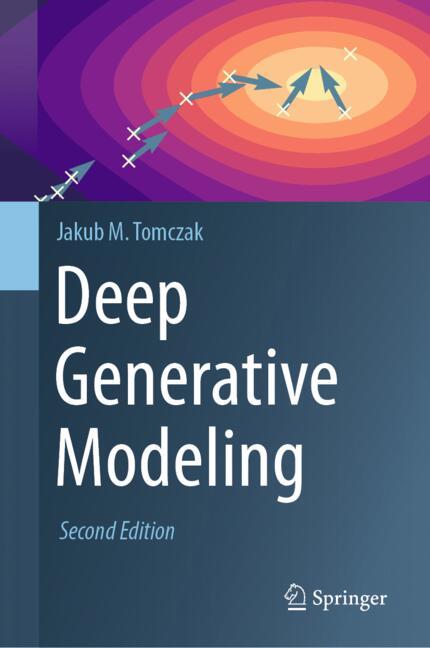
Deep Generative Modeling
☆☆☆☆☆
(0 reviews)
Lowest price (incl. delivery)
8 579,00 JPY
Typical price1 483,48 PLN
Lowest (90 days)62,39 PLN
Offers2
Last updated1 zi în urmă
| Vânzător | Product price | Delivery | Total | Disponibilitate | Updated | |
|---|---|---|---|---|---|---|
| SP Springer Nature Author | 8 579,00 JPY | free | 8 579,00 JPY | Disponibil | 1 zi în urmă | View offer |
| SP SpringerNatureLink Shop INT | 65,99 EUR | 19,00 EUR | 84,99 EUR | Disponibil | 1 zi în urmă | View offer |
Prețurile și disponibilitatea se pot modifica. Ultima actualizare: 08.08.2026 23:17.
EAN
9783031640865
Springer Nature
0,0
☆☆☆☆☆
0 reviews
5★
0%
4★
0%
3★
0%
2★
0%
1★
0%
Product reviews
No reviews yet — be the first!
This first comprehensive book on models behind Generative AI has been thoroughly revised to cover all major classes of deep generative models: mixture models, Probabilistic Circuits, Autoregressive Models, Flow-based Models, Latent Variable Models, GANs, Hybrid Models, Score-based Generative Models, Energy-based Models, and Large Language Models. In addition, Generative AI Systems are discussed, demonstrating how deep generative models can be used for neural compression, among others. Deep Generative Modeling is designed to appeal to curious students, engineers, and researchers with a modest mathematical background in undergraduate calculus, linear algebra, probability theory, and the basics of machine learning, deep learning, and programming in Python and PyTorch (or other deep learning libraries). It should find interest among students and researchers from a variety of backgrounds, including computer science, engineering, data science, physics, and bioinformatics who wish to get familiar with deep generative modeling. In order to engage with a reader, the book introduces fundamental concepts with specific examples and code snippets. The full code accompanying the book is available on the author's GitHub site: github.com/jmtomczak/intro_dgm The ultimate aim of the book is to outline the most important techniques in deep generative modeling and, eventually, enable readers to formulate new models and implement them.
Similar products
 Patient Safety Coaching
from $91.97
Patient Safety Coaching
from $91.97
 Ethnography and Diversity
from $69.30
Ethnography and Diversity
from $69.30
 Smart Villages
from $91.97
Smart Villages
from $91.97
 Nuclear Non-Proliferation in International Law - Volume VI
from $91.97
Nuclear Non-Proliferation in International Law - Volume VI
from $91.97
 The Price of Freedom
from $91.97
The Price of Freedom
from $91.97
 Eco-Social Policy in the OECD and the World Bank
from $91.97
Eco-Social Policy in the OECD and the World Bank
from $91.97
 Special Topics in Policing
from $122.58
Special Topics in Policing
from $122.58
 Music from the Heart
from $91.97
Music from the Heart
from $91.97