
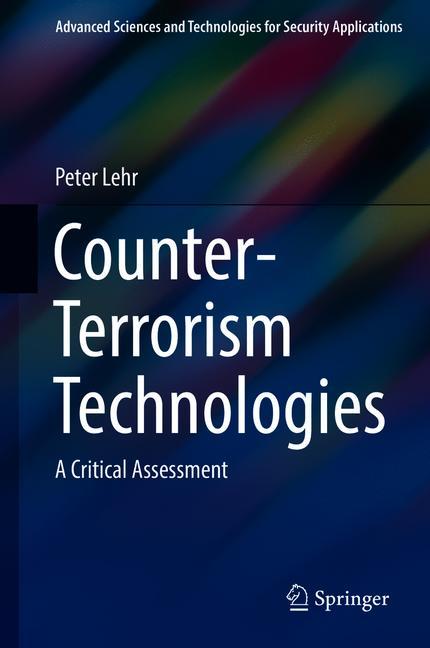
Counter-Terrorism Technologies
☆☆☆☆☆
(0 reviews)
Lowest price (incl. delivery)
14 900,00 JPY
Typical price5 038,67 PLN
Lowest (90 days)122,50 PLN
Offers3
Last updated1 săptămână în urmă
| Vânzător | Product price | Delivery | Total | Disponibilitate | Updated | |
|---|---|---|---|---|---|---|
| SP SpringerNatureLink Shop INT | 14 871,00 JPY | 29,00 JPY | 14 900,00 JPY | Disponibil | 6 zile în urmă | View offer |
| SP Springer Nature Author | 14 871,00 JPY | 25,00 JPY | 14 896,00 JPY | Disponibil | 1 săptămână în urmă | View offer |
| SP SpringerNatureLink Shop INT | 122,50 EUR | 19,00 EUR | 141,50 EUR | Disponibil | 1 săptămână în urmă | View offer |
Prețurile și disponibilitatea se pot modifica. Ultima actualizare: 08.08.2026 23:25.
EAN
9783319909240
Springer Nature
0,0
☆☆☆☆☆
0 reviews
5★
0%
4★
0%
3★
0%
2★
0%
1★
0%
Product reviews
No reviews yet — be the first!
This book critically discusses the role of technology for counter-terrorism in general, and for securing our vulnerable open societies in particular. It is set against the backdrop of the terrorist threat posed by the combined forces of Al Qaeda and ISIS/Daesh in the foreseeable future. The book commences by illuminating current and foreseeable tactics and weapons used by these implacable enemies – weapons that may well include chemical, biological, radiological and potentially even nuclear (CBRN) devices. In a second part, it introduces technologies already available or in development that promise an increase in safety and security when it comes to the dangers posed by these terrorists. This part also includes a critical discussion of advantages and disadvantages of such technologies that are, quite often, sold as a ‘silver bullet’ approach in the fight against terrorism. Controversies such as those triggered by the abuse of millimeter wave scanners deployed at severalWestern European airports will demonstrate that there are costs involved with regard to human rights. The third, analytical part takes the critical discussion further by arguing that the uncritical fielding of new surveillance and control technologies in parallel with the on-going outsourcing and privatization of key services of the state could well lead to dystopias as envisaged in a rather prescient way by the so-called cyperpunk novels of the 1980s. The book concludes with the question that any liberal democracy should ask itself: how far can we go with regard to hardening our societies against terrorist threats?
Similar products
 50 Years of Philosophy and Medicine
from $107.30
50 Years of Philosophy and Medicine
from $107.30
 Understanding Cybersecurity Law and Digital Privacy
from $122.63
Understanding Cybersecurity Law and Digital Privacy
from $122.63
 Decisions in International Trade and Logistics
from $122.63
Decisions in International Trade and Logistics
from $122.63
 Advances in Economic Measurement
from $122.63
Advances in Economic Measurement
from $122.63
 Nanomaterials
from $137.96
Nanomaterials
from $137.96
 Sustainable Scaffolds-based Strategies in Tissue Engineering and Regenerative Medicine
from $162.87
Sustainable Scaffolds-based Strategies in Tissue Engineering and Regenerative Medicine
from $162.87
 Narratives in Educational Research
from $162.87
Narratives in Educational Research
from $162.87
 Environmental Biology of the Young Chinese Sturgeon
from $210.78
Environmental Biology of the Young Chinese Sturgeon
from $210.78