
Calculus for Computer Graphics
☆☆☆☆☆
(0 reviews)
Lowest price (incl. delivery)
68,05 EUR
Typical price7 435,00 PLN
Lowest (90 days)7 435,00 PLN
Offers3
Last updated1 săptămână în urmă
| Vânzător | Product price | Delivery | Total | Disponibilitate | Updated | |
|---|---|---|---|---|---|---|
| SP SpringerNatureLink Shop INT | 43,05 EUR | 25,00 EUR | 68,05 EUR | Disponibil | 2 zile în urmă | View offer |
| SP SpringerNatureLink Shop INT | 7 435,00 JPY | 29,00 JPY | 7 464,00 JPY | Disponibil | 2 zile în urmă | View offer |
| SP Springer Nature Author | 7 435,00 JPY | 29,00 JPY | 7 464,00 JPY | Disponibil | 1 săptămână în urmă | View offer |
Prețurile și disponibilitatea se pot modifica. Ultima actualizare: 08.08.2026 23:16.
EAN
9783031281174
Springer Nature
0,0
☆☆☆☆☆
0 reviews
5★
0%
4★
0%
3★
0%
2★
0%
1★
0%
Product reviews
No reviews yet — be the first!
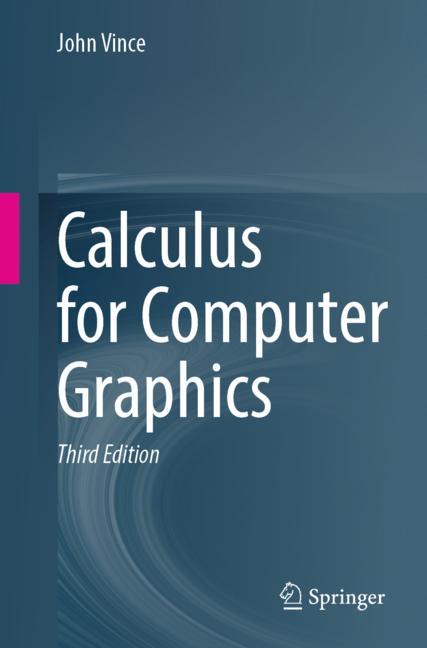
Students studying different branches of computer graphics need to be familiar with geometry, matrices, vectors, rotation transforms, quaternions, curves and surfaces. And as computer graphics software becomes increasingly sophisticated, calculus is also being used to resolve its associated problems. In this 3rd edition, the author extends the scope of the original book to include vector differential operators and differential equations and draws upon his experience in teaching mathematics to undergraduates to make calculus appear no more challenging than any other branch of mathematics. He introduces the subject by examining how functions depend upon their independent variables, and then derives the appropriate mathematical underpinning and definitions. This gives rise to a function’s derivative and its antiderivative, or integral. Using the idea of limits, the reader is introduced to derivatives and integrals of many common functions. Other chapters address higher-order derivatives, partial derivatives, Jacobians, vector-based functions, single, double and triple integrals, with numerous worked examples and almost two hundred colour illustrations. This book complements the author’s other books on mathematics for computer graphics and assumes that the reader is familiar with everyday algebra, trigonometry, vectors and determinants. After studying this book, the reader should understand calculus and its application within the world of computer graphics, games and animation.
Similar products
 50 Years of Philosophy and Medicine
from $107.30
50 Years of Philosophy and Medicine
from $107.30
 Understanding Cybersecurity Law and Digital Privacy
from $122.63
Understanding Cybersecurity Law and Digital Privacy
from $122.63
 Decisions in International Trade and Logistics
from $122.63
Decisions in International Trade and Logistics
from $122.63
 Advances in Economic Measurement
from $122.63
Advances in Economic Measurement
from $122.63
 Nanomaterials
from $137.96
Nanomaterials
from $137.96
 Sustainable Scaffolds-based Strategies in Tissue Engineering and Regenerative Medicine
from $162.87
Sustainable Scaffolds-based Strategies in Tissue Engineering and Regenerative Medicine
from $162.87
 Narratives in Educational Research
from $162.87
Narratives in Educational Research
from $162.87
 Environmental Biology of the Young Chinese Sturgeon
from $210.78
Environmental Biology of the Young Chinese Sturgeon
from $210.78