
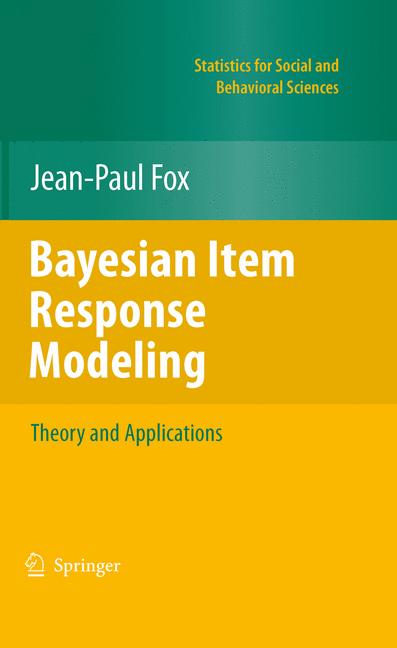
Bayesian Item Response Modeling
☆☆☆☆☆
(0 reviews)
Lowest price (incl. delivery)
21 474,00 JPY
Typical price4 050,45 PLN
Lowest (90 days)155,99 PLN
Offers7
Last updated1 săptămână în urmă
Price history (90 days)
Full history
2026-08-08
2026-08-15
| Actualizat la | Preț |
|---|---|
| 2026-08-08 | 155,99 |
| 2026-08-15 | 158,24 |
| Vânzător | Product price | Delivery | Total | Disponibilitate | Updated | |
|---|---|---|---|---|---|---|
| SP SpringerNatureLink Shop INT | 21 449,00 JPY | 25,00 JPY | 21 474,00 JPY | Disponibil | 6 zile în urmă | View offer |
| SP Springer Nature Author | 21 449,00 JPY | free | 21 449,00 JPY | Disponibil | 1 săptămână în urmă | View offer |
| SP SpringerNatureLink Shop INT | 149,99 USD | 15,00 USD | 164,99 USD | Disponibil | 6 zile în urmă | View offer |
| SP SpringerNatureLink Shop INT | 155,99 EUR | 25,00 EUR | 180,99 EUR | Disponibil | 6 zile în urmă | View offer |
| SP SpringerNatureLink Shop INT | 169,00 USD | 25,00 USD | 194,00 USD | Disponibil | 6 zile în urmă | View offer |
| SP SpringerNatureLink Shop INT | 169,00 USD | 19,00 USD | 188,00 USD | Disponibil | 6 zile în urmă | View offer |
| SP SpringerNatureLink Shop INT | 177,00 EUR | free | 177,00 EUR | Disponibil | 6 zile în urmă | View offer |
Prețurile și disponibilitatea se pot modifica. Ultima actualizare: 08.08.2026 23:34.
0,0
☆☆☆☆☆
0 reviews
5★
0%
4★
0%
3★
0%
2★
0%
1★
0%
Product reviews
No reviews yet — be the first!
The modeling of item response data is governed by item response theory, also referred to as modern test theory. The eld of inquiry of item response theory has become very large and shows the enormous progress that has been made. The mainstream literature is focused on frequentist statistical methods for - timating model parameters and evaluating model t. However, the Bayesian methodology has shown great potential, particularly for making further - provements in the statistical modeling process. The Bayesian approach has two important features that make it attractive for modeling item response data. First, it enables the possibility of incorpor- ing nondata information beyond the observed responses into the analysis. The Bayesian methodology is also very clear about how additional information can be used. Second, the Bayesian approach comes with powerful simulation-based estimation methods. These methods make it possible to handle all kinds of priors and data-generating models. One of my motives for writing this book is to give an introduction to the Bayesian methodology for modeling and analyzing item response data. A Bayesian counterpart is presented to the many popular item response theory books (e.g., Baker and Kim 2004; De Boeck and Wilson, 2004; Hambleton and Swaminathan, 1985; van der Linden and Hambleton, 1997) that are mainly or completely focused on frequentist methods. The usefulness of the Bayesian methodology is illustrated by discussing and applying a range of Bayesian item response models.
Similar products
 50 Years of Philosophy and Medicine
from $107.30
50 Years of Philosophy and Medicine
from $107.30
 Understanding Cybersecurity Law and Digital Privacy
from $122.63
Understanding Cybersecurity Law and Digital Privacy
from $122.63
 Decisions in International Trade and Logistics
from $122.63
Decisions in International Trade and Logistics
from $122.63
 Advances in Economic Measurement
from $122.63
Advances in Economic Measurement
from $122.63
 Nanomaterials
from $137.96
Nanomaterials
from $137.96
 Sustainable Scaffolds-based Strategies in Tissue Engineering and Regenerative Medicine
from $162.87
Sustainable Scaffolds-based Strategies in Tissue Engineering and Regenerative Medicine
from $162.87
 Narratives in Educational Research
from $162.87
Narratives in Educational Research
from $162.87
 Environmental Biology of the Young Chinese Sturgeon
from $210.78
Environmental Biology of the Young Chinese Sturgeon
from $210.78