
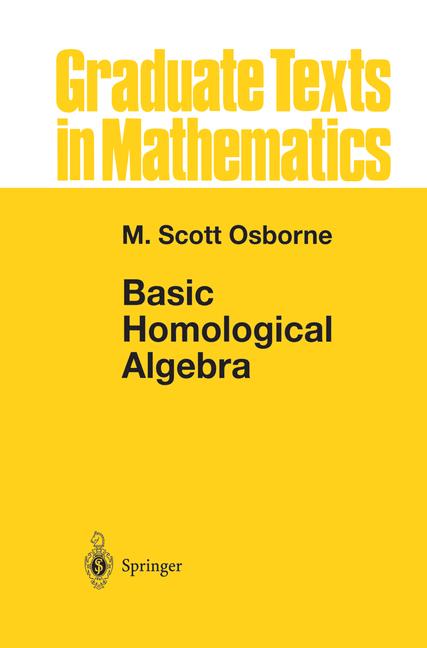
Basic Homological Algebra
☆☆☆☆☆
(0 reviews)
Lowest price (incl. delivery)
71,20 EUR
Typical price46,20 PLN
Lowest (90 days)46,20 PLN
Offers3
Last updated6 zile în urmă
Price history (90 days)
Full history
2026-08-08
2026-08-15
| Actualizat la | Preț |
|---|---|
| 2026-08-08 | 46,20 |
| 2026-08-15 | 46,20 |
| Vânzător | Product price | Delivery | Total | Disponibilitate | Updated | |
|---|---|---|---|---|---|---|
| SP SpringerNatureLink Shop INT | 46,20 EUR | 25,00 EUR | 71,20 EUR | Disponibil | 6 zile în urmă | View offer |
| SP Springer Nature Author | 46,20 EUR | free | 46,20 EUR | Disponibil | 1 săptămână în urmă | View offer |
| SP SpringerNatureLink Shop INT | 8 007,00 JPY | 15,00 JPY | 8 022,00 JPY | Disponibil | 6 zile în urmă | View offer |
Prețurile și disponibilitatea se pot modifica. Ultima actualizare: 15.08.2026 07:53.
EAN
9781461212782
Springer Nature
0,0
☆☆☆☆☆
0 reviews
5★
0%
4★
0%
3★
0%
2★
0%
1★
0%
Product reviews
No reviews yet — be the first!
Five years ago, I taught a one-quarter course in homological algebra. I discovered that there was no book which was really suitable as a text for such a short course, so I decided to write one. The point was to cover both Ext and Tor early, and still have enough material for a larger course (one semester or two quarters) going off in any of several possible directions. This book is 'also intended to be readable enough for independent study. The core of the subject is covered in Chapters 1 through 3 and the first two sections ofChapter 4. At that point there are several options. Chapters 4 and 5 cover the more traditional aspects of dimension and ring changes. Chapters 6 and 7 cover derived functors in general. Chapter 8 focuses on a special property of Tor. These three groupings are independent, as are various sections from Chapter 9, which is intended as a source of special topics. (The prerequisites for each section of Chapter 9 are stated at the beginning.) Some things have been included simply because they are hard to find else where, and they naturally fit into the discussion. Lazard's theorem (Section 8.4)-is an example; Sections4,5, and 7ofChapter 9 containother examples, as do the appendices at the end.
Similar products
 50 Years of Philosophy and Medicine
from $107.30
50 Years of Philosophy and Medicine
from $107.30
 Understanding Cybersecurity Law and Digital Privacy
from $122.63
Understanding Cybersecurity Law and Digital Privacy
from $122.63
 Decisions in International Trade and Logistics
from $122.63
Decisions in International Trade and Logistics
from $122.63
 Advances in Economic Measurement
from $122.63
Advances in Economic Measurement
from $122.63
 Nanomaterials
from $137.96
Nanomaterials
from $137.96
 Sustainable Scaffolds-based Strategies in Tissue Engineering and Regenerative Medicine
from $162.87
Sustainable Scaffolds-based Strategies in Tissue Engineering and Regenerative Medicine
from $162.87
 Narratives in Educational Research
from $162.87
Narratives in Educational Research
from $162.87
 Environmental Biology of the Young Chinese Sturgeon
from $210.78
Environmental Biology of the Young Chinese Sturgeon
from $210.78