
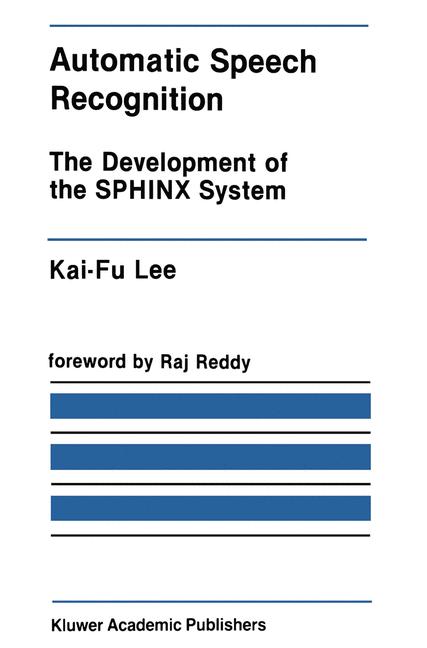
Automatic Speech Recognition
☆☆☆☆☆
(0 reviews)
Lowest price (incl. delivery)
118,50 GBP
Typical price3 159,19 PLN
Lowest (90 days)117,69 PLN
Offers2
Last updated4 zile în urmă
| Vânzător | Product price | Delivery | Total | Disponibilitate | Updated | |
|---|---|---|---|---|---|---|
| SP SpringerNatureLink Shop INT | 103,50 GBP | 15,00 GBP | 118,50 GBP | Disponibil | 4 zile în urmă | View offer |
| SP Springer Nature Author | 21 449,00 JPY | free | 21 449,00 JPY | Disponibil | 4 zile în urmă | View offer |
Prețurile și disponibilitatea se pot modifica. Ultima actualizare: 08.08.2026 23:28.
0,0
☆☆☆☆☆
0 reviews
5★
0%
4★
0%
3★
0%
2★
0%
1★
0%
Product reviews
No reviews yet — be the first!
Speech Recognition has a long history of being one of the difficult problems in Artificial Intelligence and Computer Science. As one goes from problem solving tasks such as puzzles and chess to perceptual tasks such as speech and vision, the problem characteristics change dramatically: knowledge poor to knowledge rich; low data rates to high data rates; slow response time (minutes to hours) to instantaneous response time. These characteristics taken together increase the computational complexity of the problem by several orders of magnitude. Further, speech provides a challenging task domain which embodies many of the requirements of intelligent behavior: operate in real time; exploit vast amounts of knowledge, tolerate errorful, unexpected unknown input; use symbols and abstractions; communicate in natural language and learn from the environment. Voice input to computers offers a number of advantages. It provides a natural, fast, hands free, eyes free, location free input medium. However, there are many as yet unsolved problems that prevent routine use of speech as an input device by non-experts. These include cost, real time response, speaker independence, robustness to variations such as noise, microphone, speech rate and loudness, and the ability to handle non-grammatical speech. Satisfactory solutions to each of these problems can be expected within the next decade. Recognition of unrestricted spontaneous continuous speech appears unsolvable at present. However, by the addition of simple constraints, such as clarification dialog to resolve ambiguity, we believe it will be possible to develop systems capable of accepting very large vocabulary continuous speechdictation.
Similar products
 Patient Safety Coaching
from $91.97
Patient Safety Coaching
from $91.97
 Ethnography and Diversity
from $69.30
Ethnography and Diversity
from $69.30
 Smart Villages
from $91.97
Smart Villages
from $91.97
 Nuclear Non-Proliferation in International Law - Volume VI
from $91.97
Nuclear Non-Proliferation in International Law - Volume VI
from $91.97
 The Price of Freedom
from $91.97
The Price of Freedom
from $91.97
 Eco-Social Policy in the OECD and the World Bank
from $91.97
Eco-Social Policy in the OECD and the World Bank
from $91.97
 Special Topics in Policing
from $122.58
Special Topics in Policing
from $122.58
 Music from the Heart
from $91.97
Music from the Heart
from $91.97