
Artificial Nucleases
☆☆☆☆☆
(0 reviews)
Lowest price (incl. delivery)
42 914,00 JPY
Typical price4 588,21 PLN
Lowest (90 days)316,49 PLN
Offers3
Last updated1 săptămână în urmă
Price history (90 days)
Full history
2026-08-08
2026-08-15
| Actualizat la | Preț |
|---|---|
| 2026-08-08 | 320,99 |
| 2026-08-15 | 316,49 |
| Vânzător | Product price | Delivery | Total | Disponibilitate | Updated | |
|---|---|---|---|---|---|---|
| SP SpringerNatureLink Shop INT | 42 899,00 JPY | 15,00 JPY | 42 914,00 JPY | Disponibil | 6 zile în urmă | View offer |
| SP Springer Nature Author | 42 899,00 JPY | 15,00 JPY | 42 914,00 JPY | Disponibil | 1 săptămână în urmă | View offer |
| SP SpringerNatureLink Shop INT | 354,00 EUR | 15,00 EUR | 369,00 EUR | Disponibil | 6 zile în urmă | View offer |
Prețurile și disponibilitatea se pot modifica. Ultima actualizare: 08.08.2026 23:40.
EAN
9783642621390
Springer Nature
0,0
☆☆☆☆☆
0 reviews
5★
0%
4★
0%
3★
0%
2★
0%
1★
0%
Product reviews
No reviews yet — be the first!
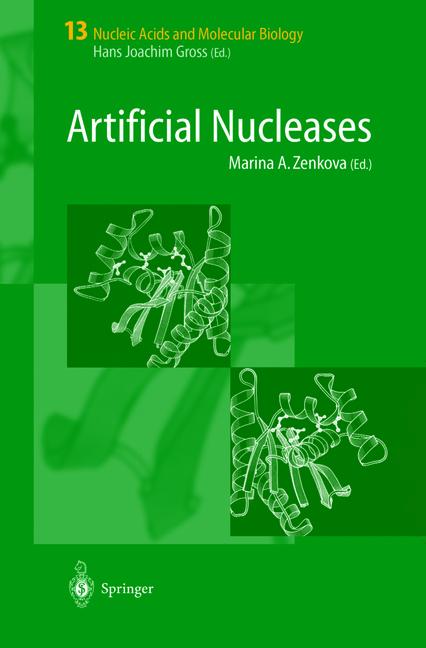
The development of agents capable of cleaving RNA and DNA has attracted considerable attention from researchers in the last few years, because of the immediate and very important applications they can find in the emerging fields of biotechnology and pharmacology. There are essentially two classes of these agents - nucleases that occur naturally inside cells and synthetically produced artificial nucleases. The first class includes protein enzyme nucle ases and catalytic RNA structured ribozymes that perform cleavage of the phosphodiester bonds in nucleic acids according to a hydrolytic pathway in the course of different biochemical processes in the cell. A different pathway is used by some antibiotics which cleave DNA via redox-based mechanisms resulting in oxidative damage of nucleotide units and breakage of the DNA backbone. The above molecules are indispensable tools for manipulating nucleic acids and processing RNA; DNA-cleaving antibiotics and cytotoxic ribonucleases have demonstrated utility as chemotherapeutic agents. The second class, artificial nucleases, are rationally designed to imitate the active centers of natural enzymes by simple structures possessing minimal sets of the most important characteristics that are essential for catalysis. A dif ferent approach, in vitro selection, was also used to create artificial RNA and DNA enzymes capable of cleaving RNA. Being less efficient and specific as compared to the natural enzymes, the primitive mimics are smaller and robust and can function in a broad range of conditions.
Similar products
 50 Years of Philosophy and Medicine
from $107.30
50 Years of Philosophy and Medicine
from $107.30
 Understanding Cybersecurity Law and Digital Privacy
from $122.63
Understanding Cybersecurity Law and Digital Privacy
from $122.63
 Decisions in International Trade and Logistics
from $122.63
Decisions in International Trade and Logistics
from $122.63
 Advances in Economic Measurement
from $122.63
Advances in Economic Measurement
from $122.63
 Nanomaterials
from $137.96
Nanomaterials
from $137.96
 Sustainable Scaffolds-based Strategies in Tissue Engineering and Regenerative Medicine
from $162.87
Sustainable Scaffolds-based Strategies in Tissue Engineering and Regenerative Medicine
from $162.87
 Narratives in Educational Research
from $162.87
Narratives in Educational Research
from $162.87
 Environmental Biology of the Young Chinese Sturgeon
from $210.78
Environmental Biology of the Young Chinese Sturgeon
from $210.78