
An Introduction to Structural Optimization
☆☆☆☆☆
(0 reviews)
Lowest price (incl. delivery)
7 883,00 JPY
Typical price710,99 PLN
Lowest (90 days)57,19 PLN
Offers3
Last updated1 săptămână în urmă
Price history (90 days)
Full history
2026-08-08
2026-08-15
| Actualizat la | Preț |
|---|---|
| 2026-08-08 | 57,19 |
| 2026-08-15 | 57,19 |
| Vânzător | Product price | Delivery | Total | Disponibilitate | Updated | |
|---|---|---|---|---|---|---|
| SP SpringerNatureLink Shop INT | 7 864,00 JPY | 19,00 JPY | 7 883,00 JPY | Disponibil | 1 săptămână în urmă | View offer |
| SP Springer Nature Author | 7 864,00 JPY | free | 7 864,00 JPY | Disponibil | 1 săptămână în urmă | View offer |
| SP SpringerNatureLink Shop INT | 65,00 EUR | 19,00 EUR | 84,00 EUR | Disponibil | 1 săptămână în urmă | View offer |
Prețurile și disponibilitatea se pot modifica. Ultima actualizare: 08.08.2026 23:16.
EAN
9789048179473
Springer Nature
0,0
☆☆☆☆☆
0 reviews
5★
0%
4★
0%
3★
0%
2★
0%
1★
0%
Product reviews
No reviews yet — be the first!
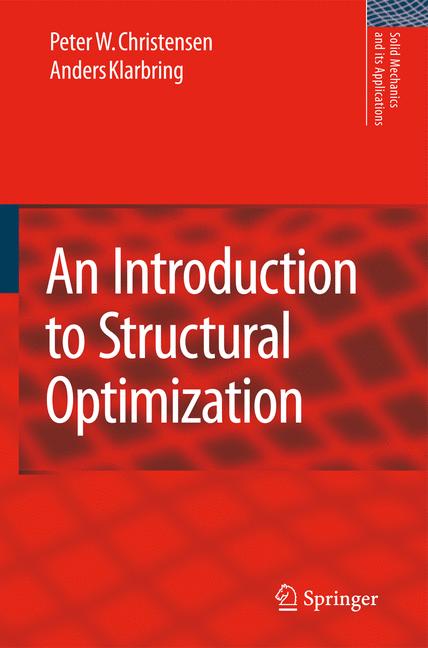
This book has grown out of lectures and courses given at Linköping University, Sweden, over a period of 15 years. It gives an introductory treatment of problems and methods of structural optimization. The three basic classes of geometrical - timization problems of mechanical structures, i. e. , size, shape and topology op- mization, are treated. The focus is on concrete numerical solution methods for d- crete and (?nite element) discretized linear elastic structures. The style is explicit and practical: mathematical proofs are provided when arguments can be kept e- mentary but are otherwise only cited, while implementation details are frequently provided. Moreover, since the text has an emphasis on geometrical design problems, where the design is represented by continuously varying—frequently very many— variables, so-called ?rst order methods are central to the treatment. These methods are based on sensitivity analysis, i. e. , on establishing ?rst order derivatives for - jectives and constraints. The classical ?rst order methods that we emphasize are CONLIN and MMA, which are based on explicit, convex and separable appro- mations. It should be remarked that the classical and frequently used so-called op- mality criteria method is also of this kind. It may also be noted in this context that zero order methods such as response surface methods, surrogate models, neural n- works, genetic algorithms, etc. , essentially apply to different types of problems than the ones treated here and should be presented elsewhere.
Similar products
 50 Years of Philosophy and Medicine
from $107.30
50 Years of Philosophy and Medicine
from $107.30
 Understanding Cybersecurity Law and Digital Privacy
from $122.63
Understanding Cybersecurity Law and Digital Privacy
from $122.63
 Decisions in International Trade and Logistics
from $122.63
Decisions in International Trade and Logistics
from $122.63
 Advances in Economic Measurement
from $122.63
Advances in Economic Measurement
from $122.63
 Nanomaterials
from $137.96
Nanomaterials
from $137.96
 Sustainable Scaffolds-based Strategies in Tissue Engineering and Regenerative Medicine
from $162.87
Sustainable Scaffolds-based Strategies in Tissue Engineering and Regenerative Medicine
from $162.87
 Narratives in Educational Research
from $162.87
Narratives in Educational Research
from $162.87
 Environmental Biology of the Young Chinese Sturgeon
from $210.78
Environmental Biology of the Young Chinese Sturgeon
from $210.78