
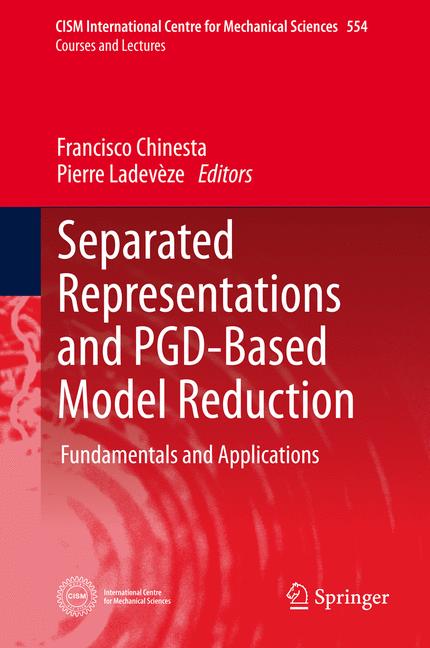
Separated Representations and PGD-Based Model Reduction
☆☆☆☆☆
(0 reviews)
Lowest price (incl. delivery)
14 318,00 JPY
Typical price1 079,89 PLN
Lowest (90 days)71,50 PLN
Offers6
Last updatedhá 1 semana
Price history (90 days)
Full history
2026-08-08
2026-08-15
| Atualizado em | Preço |
|---|---|
| 2026-08-08 | 84,99 |
| 2026-08-15 | 71,50 |
| Vendedor | Product price | Delivery | Total | Disponibilidade | Updated | |
|---|---|---|---|---|---|---|
| SP SpringerNatureLink Shop INT | 14 299,00 JPY | 19,00 JPY | 14 318,00 JPY | Disponível | há 5 dias | View offer |
| SP Springer Nature Author | 14 299,00 JPY | free | 14 299,00 JPY | Disponível | há 1 semana | View offer |
| SP SpringerNatureLink Shop INT | 99,99 USD | 15,00 USD | 114,99 USD | Disponível | há 6 dias | View offer |
| SP SpringerNatureLink Shop INT | 109,99 USD | free | 109,99 USD | Disponível | há 6 dias | View offer |
| SP SpringerNatureLink Shop INT | 109,99 USD | 25,00 USD | 134,99 USD | Disponível | há 6 dias | View offer |
| SP SpringerNatureLink Shop INT | 118,00 EUR | 25,00 EUR | 143,00 EUR | Disponível | há 6 dias | View offer |
Os preços e a disponibilidade podem mudar. Última Atualização: 08.08.2026 23:21.
0,0
☆☆☆☆☆
0 reviews
5★
0%
4★
0%
3★
0%
2★
0%
1★
0%
Product reviews
No reviews yet — be the first!
The papers in this volume start with a description of the construction of reduced models through a review of Proper Orthogonal Decomposition (POD) and reduced basis models, including their mathematical foundations and some challenging applications, then followed by a description of a new generation of simulation strategies based on the use of separated representations (space-parameters, space-time, space-time-parameters, space-space,…), which have led to what is known as Proper Generalized Decomposition (PGD) techniques. The models can be enriched by treating parameters as additional coordinates, leading to fast and inexpensive online calculations based on richer offline parametric solutions. Separated representations are analyzed in detail in the course, from their mathematical foundations to their most spectacular applications. It is also shown how such an approximation could evolve into a new paradigm in computational science, enabling one to circumvent various computational issues in a vast array of applications in engineering science.
Similar products
 50 Years of Philosophy and Medicine
from $107.30
50 Years of Philosophy and Medicine
from $107.30
 Understanding Cybersecurity Law and Digital Privacy
from $122.63
Understanding Cybersecurity Law and Digital Privacy
from $122.63
 Decisions in International Trade and Logistics
from $122.63
Decisions in International Trade and Logistics
from $122.63
 Advances in Economic Measurement
from $122.63
Advances in Economic Measurement
from $122.63
 Nanomaterials
from $137.96
Nanomaterials
from $137.96
 Sustainable Scaffolds-based Strategies in Tissue Engineering and Regenerative Medicine
from $162.87
Sustainable Scaffolds-based Strategies in Tissue Engineering and Regenerative Medicine
from $162.87
 Narratives in Educational Research
from $162.87
Narratives in Educational Research
from $162.87
 Environmental Biology of the Young Chinese Sturgeon
from $210.78
Environmental Biology of the Young Chinese Sturgeon
from $210.78