
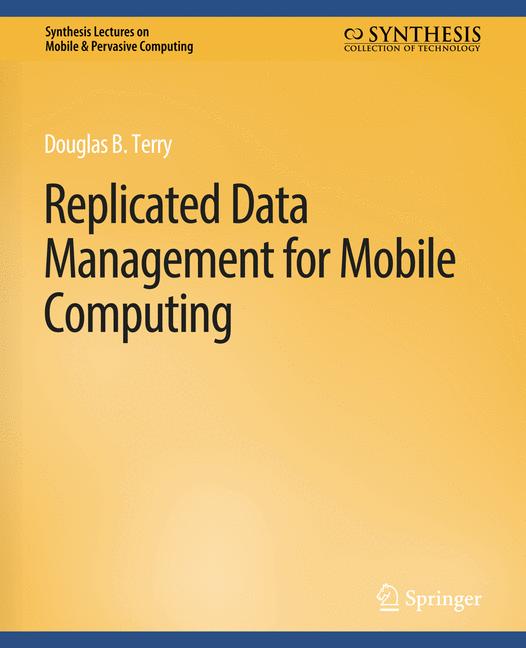
Replicated Data Management for Mobile Computing
☆☆☆☆☆
(0 reviews)
Lowest price (incl. delivery)
62,99 USD
Typical price34,13 PLN
Lowest (90 days)29,99 PLN
Offers2
Last updatedhá 1 dia
| Vendedor | Product price | Delivery | Total | Disponibilidade | Updated | |
|---|---|---|---|---|---|---|
| SP SpringerNatureLink Shop INT | 37,99 USD | 25,00 USD | 62,99 USD | Disponível | há 1 dia | View offer |
| SP Springer Nature Author | 37,99 USD | 19,00 USD | 56,99 USD | Disponível | há 18 horas | View offer |
Os preços e a disponibilidade podem mudar. Última Atualização: 08.08.2026 07:58.
0,0
☆☆☆☆☆
0 reviews
5★
0%
4★
0%
3★
0%
2★
0%
1★
0%
Product reviews
No reviews yet — be the first!
Managing data in a mobile computing environment invariably involves caching or replication. In many cases, a mobile device has access only to data that is stored locally, and much of that data arrives via replication from other devices, PCs, and services. Given portable devices with limited resources, weak or intermittent connectivity, and security vulnerabilities, data replication serves to increase availability, reduce communication costs, foster sharing, and enhance survivability of critical information. Mobile systems have employed a variety of distributed architectures from client–server caching to peer-to-peer replication. Such systems generally provide weak consistency models in which read and update operations can be performed at any replica without coordination with other devices. The design of a replication protocol then centers on issues of how to record, propagate, order, and filter updates. Some protocols utilize operation logs, whereas others replicate state. Systems might provide best-effort delivery, using gossip protocols or multicast, or guarantee eventual consistency for arbitrary communication patterns, using recently developed pairwise, knowledge-driven protocols. Additionally, systems must detect and resolve the conflicts that arise from concurrent updates using techniques ranging from version vectors to read–write dependency checks. This lecture explores the choices faced in designing a replication protocol, with particular emphasis on meeting the needs of mobile applications. It presents the inherent trade-offs and implicit assumptions in alternative designs. The discussion is grounded by including case studies of research and commercial systems including Coda, Ficus, Bayou, Sybase’s iAnywhere, and Microsoft’s Sync Framework. Table of Contents: Introduction / System Models / Data Consistency / Replicated Data Protocols / Partial Replication / Conflict Management / Case Studies / Conclusions / Bibliography
Similar products
 Patient Safety Coaching
from $91.97
Patient Safety Coaching
from $91.97
 Ethnography and Diversity
from $69.30
Ethnography and Diversity
from $69.30
 Smart Villages
from $91.97
Smart Villages
from $91.97
 Nuclear Non-Proliferation in International Law - Volume VI
from $91.97
Nuclear Non-Proliferation in International Law - Volume VI
from $91.97
 The Price of Freedom
from $91.97
The Price of Freedom
from $91.97
 Eco-Social Policy in the OECD and the World Bank
from $91.97
Eco-Social Policy in the OECD and the World Bank
from $91.97
 Special Topics in Policing
from $122.58
Special Topics in Policing
from $122.58
 Music from the Heart
from $91.97
Music from the Heart
from $91.97