
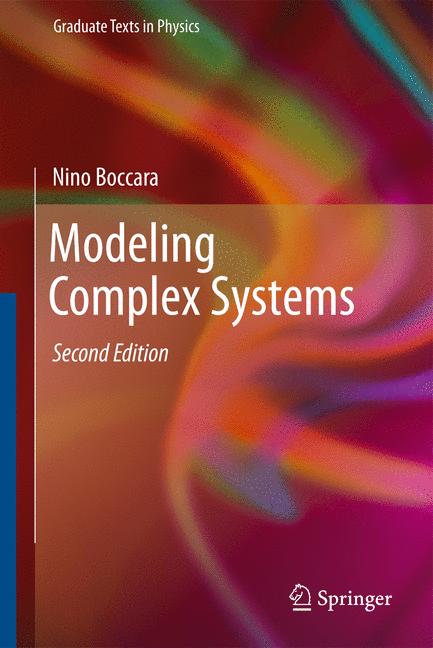
Modeling Complex Systems
☆☆☆☆☆
(0 reviews)
Lowest price (incl. delivery)
124,99 USD
Typical price83,60 PLN
Lowest (90 days)64,99 PLN
Offers1
Last updatedhá 2 horas
| Vendedor | Product price | Delivery | Total | Disponibilidade | Updated | |
|---|---|---|---|---|---|---|
| SP SpringerNatureLink Shop INT | 99,99 USD | 25,00 USD | 124,99 USD | Disponível | há 2 horas | View offer |
Os preços e a disponibilidade podem mudar. Última Atualização: 08.08.2026 13:26.
0,0
☆☆☆☆☆
0 reviews
5★
0%
4★
0%
3★
0%
2★
0%
1★
0%
Product reviews
No reviews yet — be the first!
The essential points of this ?rst chapter are • The de?nition of a complex system • The notion of emergence • The de?nition of a model • The notion of dynamical system This book is about the dynamics of complex systems. Roughly speaking, a system is a collection of interacting elements making up a whole such as, for instance, a mechanical clock. While many systems may be quite complicated, they are not necessarily considered to be complex. Today, most authors agree on the essential properties a system has to possess to be called complex. The ?rst section is devoted to the description of these properties. To interpret the time evolution of a system, scientists build up models, which are simpli?ed mathematical representations of the system. The exact purpose of a model and what its essential features should be is explained in the second section. The mathematical models that will be discussed in this book are dynami- 1 calsystems. A dynamical system is essentially a set of equations whose- lutiondescribesthe evolution,asafunction oftime, ofthe state ofthe system. There exist di?erent types of dynamical systems. Some of them are de?ned in the third section. 1 There is an extensive literature on mathematical modeling. The reader may, for example, consult [11,88,163,233].
Similar products
 Patient Safety Coaching
from $122.58
Patient Safety Coaching
from $122.58
 Ethnography and Diversity
from $85.81
Ethnography and Diversity
from $85.81
 Smart Villages
from $122.58
Smart Villages
from $122.58
 Nuclear Non-Proliferation in International Law - Volume VI
from $122.58
Nuclear Non-Proliferation in International Law - Volume VI
from $122.58
 The Price of Freedom
from $122.58
The Price of Freedom
from $122.58
 Eco-Social Policy in the OECD and the World Bank
from $122.58
Eco-Social Policy in the OECD and the World Bank
from $122.58
 Special Topics in Policing
from $122.58
Special Topics in Policing
from $122.58
 Music from the Heart
from $122.58
Music from the Heart
from $122.58