
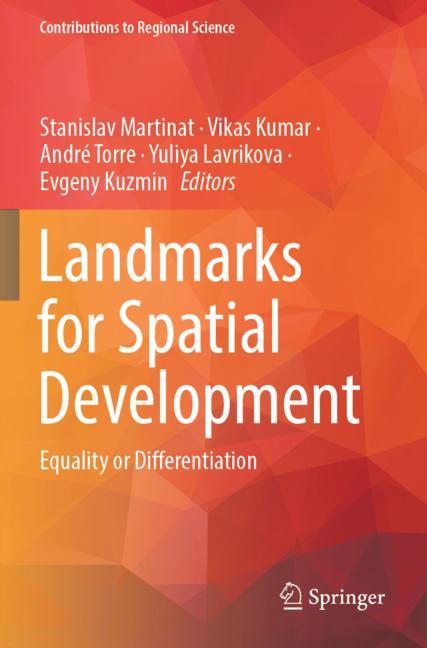
Landmarks for Spatial Development
☆☆☆☆☆
(0 reviews)
Lowest price (incl. delivery)
21 449,00 JPY
Typical price2 706,51 PLN
Lowest (90 days)117,69 PLN
Offers6
Last updatedhá 1 semana
Price history (90 days)
Full history
2026-08-08
2026-08-15
| Atualizado em | Preço |
|---|---|
| 2026-08-08 | 117,69 |
| 2026-08-15 | 117,69 |
| Vendedor | Product price | Delivery | Total | Disponibilidade | Updated | |
|---|---|---|---|---|---|---|
| SP SpringerNatureLink Shop INT | 21 449,00 JPY | free | 21 449,00 JPY | Disponível | há 1 dia | View offer |
| SP Springer Nature Author | 21 449,00 JPY | 15,00 JPY | 21 464,00 JPY | Disponível | há 1 semana | View offer |
| SP SpringerNatureLink Shop INT | 149,99 USD | free | 149,99 USD | Disponível | há 1 dia | View offer |
| SP SpringerNatureLink Shop INT | 169,99 USD | 15,00 USD | 184,99 USD | Disponível | há 1 dia | View offer |
| SP SpringerNatureLink Shop INT | 169,99 USD | 15,00 USD | 184,99 USD | Disponível | há 1 dia | View offer |
| SP SpringerNatureLink Shop INT | 177,00 EUR | free | 177,00 EUR | Disponível | há 1 dia | View offer |
Os preços e a disponibilidade podem mudar. Última Atualização: 08.08.2026 23:28.
0,0
☆☆☆☆☆
0 reviews
5★
0%
4★
0%
3★
0%
2★
0%
1★
0%
Product reviews
No reviews yet — be the first!
The book explores the uneven spatial distribution of territory resources and its implication for the sustainable development of regions and cities. The authors analyze the features of the localization of assets, paying attention to both the manifested factors and the conditions that determine the specificity of the current spatial organization. On the basis of multivariate analysis, gravity models, clustering method, as well as the evaluation of concentration parameters, the authors propose various approaches to systematize territorial units, paying special attention to the peculiarities of their economic structure, resource diffusion barriers, and quality of life parameters. The obtained results indicate the need for a differentiated approach in the choice of guidelines for the transformation of the socio-economic space, allowing the researchers to propose various transformation models for differing regions. Thus, this book presents spatial organization models for different regional economies, highlighting various approaches to achieving the Sustainable Development Goals and reducing inequality. The book seeks to balance the benefits of polarized development with the need to avoid significant interregional disparities. At the same time, the book offers various solutions for differentiating territories, distinguishing different spatial elements, and determining the most appropriate transformation options. The results obtained may be of interest to scholars in regional and spatial science as well as to professionals in the field of territorial development management.
Similar products
 50 Years of Philosophy and Medicine
from $107.30
50 Years of Philosophy and Medicine
from $107.30
 Understanding Cybersecurity Law and Digital Privacy
from $122.63
Understanding Cybersecurity Law and Digital Privacy
from $122.63
 Decisions in International Trade and Logistics
from $122.63
Decisions in International Trade and Logistics
from $122.63
 Advances in Economic Measurement
from $122.63
Advances in Economic Measurement
from $122.63
 Nanomaterials
from $137.96
Nanomaterials
from $137.96
 Sustainable Scaffolds-based Strategies in Tissue Engineering and Regenerative Medicine
from $162.87
Sustainable Scaffolds-based Strategies in Tissue Engineering and Regenerative Medicine
from $162.87
 Narratives in Educational Research
from $162.87
Narratives in Educational Research
from $162.87
 Environmental Biology of the Young Chinese Sturgeon
from $210.78
Environmental Biology of the Young Chinese Sturgeon
from $210.78