
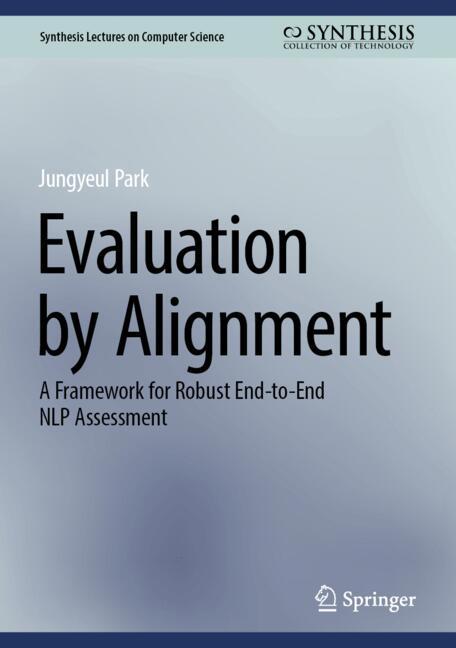
Evaluation by Alignment
☆☆☆☆☆
(0 reviews)
Lowest price (incl. delivery)
72,50 EUR
Typical price82,08 PLN
Lowest (90 days)41,59 PLN
Offers3
Last updatedhá 1 dia
| Vendedor | Product price | Delivery | Total | Disponibilidade | Updated | |
|---|---|---|---|---|---|---|
| SP SpringerNatureLink Shop INT | 47,50 EUR | 25,00 EUR | 72,50 EUR | Disponível | há 20 horas | View offer |
| SP Springer Nature Author | 47,50 EUR | 29,00 EUR | 76,50 EUR | Disponível | há 9 horas | View offer |
| VI VitalSource | 256,16 ZAR | 29,00 ZAR | 285,16 ZAR | Disponível | há 1 dia | View offer |
Os preços e a disponibilidade podem mudar. Última Atualização: 08.08.2026 05:40.
EAN
9783032165626
Springer Nature
0,0
☆☆☆☆☆
0 reviews
5★
0%
4★
0%
3★
0%
2★
0%
1★
0%
Product reviews
No reviews yet — be the first!
This book presents a novel, alignment-based evaluation framework that tackles a persistent challenge in natural language processing (NLP): how to fairly and accurately evaluate systems when preprocessing steps such as tokenization and sentence boundary detection (SBD) misalign between gold-standard and system outputs. By introducing the jointly preprocessed evaluation algorithm (jp-algorithm), this book proposes a solution that brings precision and flexibility to the assessment of modern, end-to-end NLP systems. Traditional evaluation methods assume identical sentence and token boundaries between references and hypotheses, making them poorly suited to real-world data and increasingly common end-to-end architectures. The jp-algorithm addresses these shortcomings by introducing a linear-time alignment strategy inspired by techniques in machine translation. This method allows for robust comparisons even when input segmentation differs, enabling reliable evaluation in tasks such as preprocessing, constituency parsing, and grammatical error correction (GEC). The book explores how misaligned preprocessing impacts standard evaluation metrics including PARSEVAL for constituency parsing and F0.5 for GEC and provides empirical solutions for preserving evaluation accuracy without sacrificing methodological integrity. By offering detailed case studies, formal algorithmic descriptions, and practical implementations, this book equips researchers, tool developers, and instructors with a generalizable framework for improving NLP evaluation practices. This book is intended for researchers, graduate students, and professionals working in NLP, corpus linguistics, and computational linguistics.
Similar products
 Patient Safety Coaching
from $91.97
Patient Safety Coaching
from $91.97
 Ethnography and Diversity
from $69.30
Ethnography and Diversity
from $69.30
 Smart Villages
from $91.97
Smart Villages
from $91.97
 Nuclear Non-Proliferation in International Law - Volume VI
from $91.97
Nuclear Non-Proliferation in International Law - Volume VI
from $91.97
 The Price of Freedom
from $91.97
The Price of Freedom
from $91.97
 Eco-Social Policy in the OECD and the World Bank
from $91.97
Eco-Social Policy in the OECD and the World Bank
from $91.97
 Special Topics in Policing
from $122.58
Special Topics in Policing
from $122.58
 Music from the Heart
from $91.97
Music from the Heart
from $91.97