Density Functional Theory
☆☆☆☆☆
(0 reviews)
EAN: 9783031223426
Lowest price (incl. delivery)
159,70 EUR
- Offers
- 3
- Last updated
- há 3 meses
| Vendedor | Product price | Delivery | Total | Disponibilidade | Updated | |
|---|---|---|---|---|---|---|
| SpringerNatureLink Shop INT | Product price 140,70 EUR | Delivery 19,00 EUR | Total 159,70 EUR | Disponibilidade Disponível | Updated há 2 meses | View offer |
| SpringerNatureLink Shop INT | Product price 24 309,00 JPY | Delivery 15,00 JPY | Total 24 324,00 JPY | Disponibilidade Disponível | Updated há 2 meses | View offer |
| Springer Nature Author | Product price 24 309,00 JPY ▲ 17 177,2% | Delivery free | Total 24 309,00 JPY | Disponibilidade Disponível | Updated há 3 meses | View offer |
Os preços e a disponibilidade podem mudar. Última Atualização: 08.08.2026 22:49.
EAN
9783031223426
Springer Nature
0,0
☆☆☆☆☆
0 reviews
5★
0%
4★
0%
3★
0%
2★
0%
1★
0%
Product reviews
No reviews yet — be the first!
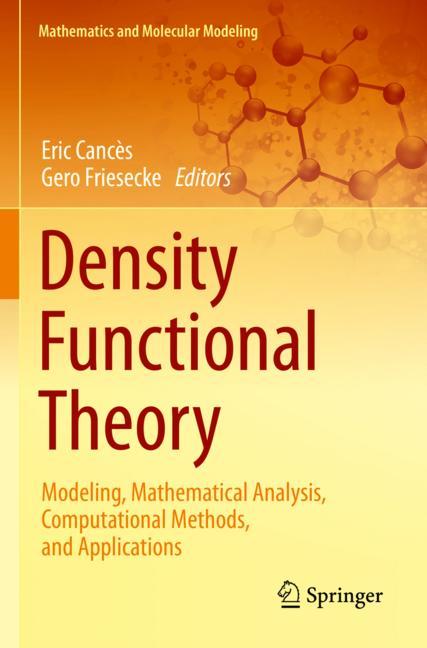
Density functional theory (DFT) provides the most widely used models for simulating molecules and materials based on the fundamental laws of quantum mechanics. It plays a central role in a huge spectrum of applications in chemistry, physics, and materials science. Quantum mechanics describes a system of N interacting particles in the physical 3-dimensional space by a partial differential equation in 3N spatial variables. The standard numerical methods thus incur an exponential increase of computational effort with N, a phenomenon known as the curse of dimensionality; in practice these methods already fail beyond N=2. DFT overcomes this problem by 1) reformulating the N-body problem involving functions of 3N variables in terms of the density, a function of 3 variables, 2) approximating it by a pioneering hybrid approach which keeps important ab initio contributions and re-models the remainder in a data-driven way. This book intends to be an accessible, yet state-of-art text on DFT for graduate students and researchers in applied and computational mathematics, physics, chemistry, and materials science. It introduces and reviews the main models of DFT, covering their derivation and mathematical properties, numerical treatment, and applications.
Similar products