
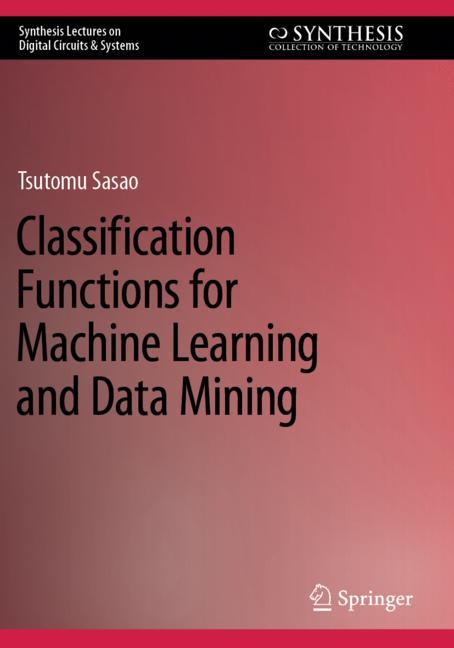
Classification Functions for Machine Learning and Data Mining
☆☆☆☆☆
(0 reviews)
Lowest price (incl. delivery)
46,00 USD
Typical price51,68 PLN
Lowest (90 days)39,99 PLN
Offers7
Last updatedhá 1 semana
Price history (90 days)
Full history
2026-08-08
2026-08-15
| Atualizado em | Preço |
|---|---|
| 2026-08-08 | 44,99 |
| 2026-08-14 | 39,99 |
| 2026-08-15 | 52,00 |
| Vendedor | Product price | Delivery | Total | Disponibilidade | Updated | |
|---|---|---|---|---|---|---|
| SP SpringerNatureLink Shop INT | 46,00 USD | free | 46,00 USD | Disponível | há 1 dia | View offer |
| SP SpringerNatureLink Shop INT | 54,99 USD | free | 54,99 USD | Disponível | há 1 dia | View offer |
| SP SpringerNatureLink Shop INT | 54,99 USD | free | 54,99 USD | Disponível | há 1 dia | View offer |
| SP SpringerNatureLink Shop INT | 59,99 USD | 29,00 USD | 88,99 USD | Disponível | há 1 dia | View offer |
| SP SpringerNatureLink Shop INT | 59,99 USD | free | 59,99 USD | Disponível | há 1 dia | View offer |
| SP Springer Nature Author | 59,99 USD | 29,00 USD | 88,99 USD | Disponível | há 1 semana | View offer |
| SP SpringerNatureLink Shop INT | 58,84 EUR | 25,00 EUR | 83,84 EUR | Disponível | há 1 dia | View offer |
Os preços e a disponibilidade podem mudar. Última Atualização: 08.08.2026 11:15.
0,0
☆☆☆☆☆
0 reviews
5★
0%
4★
0%
3★
0%
2★
0%
1★
0%
Product reviews
No reviews yet — be the first!
This book introduces a novel perspective on machine learning, offering distinct advantages over neural network-based techniques. This approach boasts a reduced hardware requirement, lower power consumption, and enhanced interpretability. The applications of this approach encompass high-speed classifications, including packet classification, network intrusion detection, and exotic particle detection in high-energy physics. Moreover, it finds utility in medical diagnosis scenarios characterized by small training sets and imbalanced data. The resulting rule generated by this method can be implemented either in software or hardware. In the case of hardware implementation, circuit design can employ look-up tables (memory), rather than threshold gates. The methodology described in this book involves extracting a set of rules from a training set, composed of categorical variable vectors and their corresponding classes. Unnecessary variables are eliminated, and the rules are simplified before being transformed into a sum-of-products (SOP) form. The resulting SOP exhibits the ability to generalize and predict outputs for new inputs. The effectiveness of this approach is demonstrated through numerous examples and experimental results using the University of California-Irvine (UCI) dataset. This book is primarily intended for graduate students and researchers in the fields of logic synthesis, machine learning, and data mining. It assumes a foundational understanding of logic synthesis, while familiarity with linear algebra and statistics would be beneficial for readers.
Similar products
 50 Years of Philosophy and Medicine
from $107.30
50 Years of Philosophy and Medicine
from $107.30
 Understanding Cybersecurity Law and Digital Privacy
from $122.63
Understanding Cybersecurity Law and Digital Privacy
from $122.63
 Decisions in International Trade and Logistics
from $122.63
Decisions in International Trade and Logistics
from $122.63
 Advances in Economic Measurement
from $122.63
Advances in Economic Measurement
from $122.63
 Nanomaterials
from $137.96
Nanomaterials
from $137.96
 Sustainable Scaffolds-based Strategies in Tissue Engineering and Regenerative Medicine
from $162.87
Sustainable Scaffolds-based Strategies in Tissue Engineering and Regenerative Medicine
from $162.87
 Narratives in Educational Research
from $162.87
Narratives in Educational Research
from $162.87
 Environmental Biology of the Young Chinese Sturgeon
from $210.78
Environmental Biology of the Young Chinese Sturgeon
from $210.78