
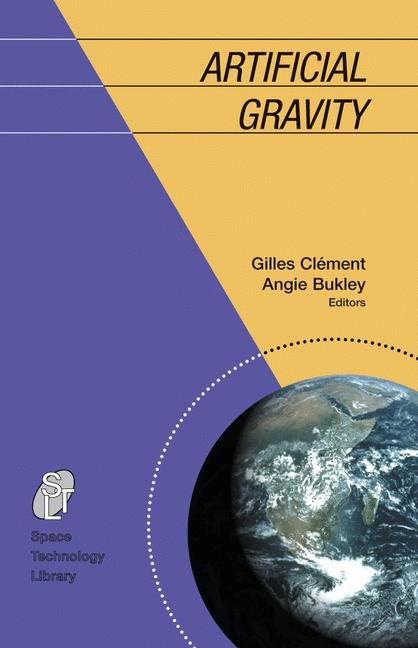
Artificial Gravity
☆☆☆☆☆
(0 reviews)
Lowest price (incl. delivery)
25 192,00 JPY
Typical price8 527,67 PLN
Lowest (90 days)208,00 PLN
Offers3
Last updatedhá 1 semana
Price history (90 days)
Full history
2026-08-08
2026-08-15
| Atualizado em | Preço |
|---|---|
| 2026-08-08 | 208,00 |
| 2026-08-15 | 208,00 |
| Vendedor | Product price | Delivery | Total | Disponibilidade | Updated | |
|---|---|---|---|---|---|---|
| SP SpringerNatureLink Shop INT | 25 167,00 JPY | 25,00 JPY | 25 192,00 JPY | Disponível | há 1 dia | View offer |
| SP Springer Nature Author | 25 167,00 JPY | 19,00 JPY | 25 186,00 JPY | Disponível | há 1 semana | View offer |
| SP SpringerNatureLink Shop INT | 208,00 EUR | 19,00 EUR | 227,00 EUR | Disponível | há 1 dia | View offer |
Os preços e a disponibilidade podem mudar. Última Atualização: 08.08.2026 23:37.
EAN
9780387707143
Springer Nature
0,0
☆☆☆☆☆
0 reviews
5★
0%
4★
0%
3★
0%
2★
0%
1★
0%
Product reviews
No reviews yet — be the first!
William H. Paloski, Ph. D. Human Adaptation and Countermeasures Office NASA Johnson Space Center Artificial gravity is an old concept, having gotten its start in the late in the 19th century when Konstantin Tsiolkovsky, considered by many to be the father of the Russian space program, realized that the human body might not respond well to the free fall of orbital space flight. To solve this problem, he proposed that space stations be rotated to create centripetal accelerations that might provide inertial loading similar to terrestrial gravitational loading. Einstein later showed in his equivalence principle that acceleration is indeed indistinguishable from gravity. Subsequently, other individuals of note, including scientists like Werner von Braun as well as artists like Arthur C. Clarke and Stanley Kubrick, devised elaborate solutions for spinning vehicles to provide “artificial gravity” that would offset the untoward physiological consequences of spaceflight. By 1959, concerns about the then-unknown human responses to spaceflight drove NASA to consider the necessity of incorporating artificial gravity in its earliest human space vehicles. Of course, owing in part to the relatively short durations of the planned missions, artificial gravity was not used in the early NASA programs.
Similar products
 50 Years of Philosophy and Medicine
from $107.30
50 Years of Philosophy and Medicine
from $107.30
 Understanding Cybersecurity Law and Digital Privacy
from $122.63
Understanding Cybersecurity Law and Digital Privacy
from $122.63
 Decisions in International Trade and Logistics
from $122.63
Decisions in International Trade and Logistics
from $122.63
 Advances in Economic Measurement
from $122.63
Advances in Economic Measurement
from $122.63
 Nanomaterials
from $137.96
Nanomaterials
from $137.96
 Sustainable Scaffolds-based Strategies in Tissue Engineering and Regenerative Medicine
from $162.87
Sustainable Scaffolds-based Strategies in Tissue Engineering and Regenerative Medicine
from $162.87
 Narratives in Educational Research
from $162.87
Narratives in Educational Research
from $162.87
 Environmental Biology of the Young Chinese Sturgeon
from $210.78
Environmental Biology of the Young Chinese Sturgeon
from $210.78