
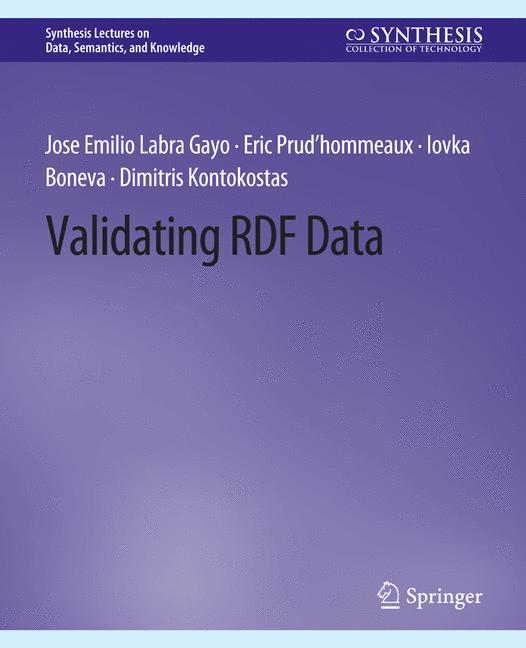
Validating RDF Data
☆☆☆☆☆
(0 opinii)
Najniższa cena (z dostawą)
63,94 USD
Typowa cena2 259,10 PLN
Najniższa (90 dni)38,94 PLN
Liczba ofert4
Ostatnia aktualizacja1 tydzień temu
Historia ceny (90 dni)
Pełna historia
2026-08-08
2026-08-15
| Zaktualizowano | Cena |
|---|---|
| 2026-08-08 | 38,94 |
| 2026-08-15 | 43,40 |
| Sprzedawca | Cena produktu | Dostawa | Razem | Dostępność | Aktualizacja | |
|---|---|---|---|---|---|---|
| SP SpringerNatureLink Shop INT | 38,94 USD | 25,00 USD | 63,94 USD | Dostępny | 4 dni temu | Zobacz ofertę |
| SP SpringerNatureLink Shop INT | 43,40 EUR | 15,00 EUR | 58,40 EUR | Dostępny | 4 dni temu | Zobacz ofertę |
| SP SpringerNatureLink Shop INT | 7 435,00 JPY | 25,00 JPY | 7 460,00 JPY | Dostępny | 4 dni temu | Zobacz ofertę |
| SP Springer Nature Author | 7 435,00 JPY | 29,00 JPY | 7 464,00 JPY | Dostępny | 1 tydzień temu | Zobacz ofertę |
Ceny i dostępność mogą ulec zmianie. Ostatnia aktualizacja: 08.08.2026 23:16.
EAN
9783031794780
Springer Nature
0,0
☆☆☆☆☆
0 opinii
5★
0%
4★
0%
3★
0%
2★
0%
1★
0%
Opinie o produkcie
Brak opinii — bądź pierwszy!
RDF and Linked Data have broad applicability across many fields, from aircraft manufacturing to zoology. Requirements for detecting bad data differ across communities, fields, and tasks, but nearly all involve some form of data validation. This book introduces data validation and describes its practical use in day-to-day data exchange. The Semantic Web offers a bold, new take on how to organize, distribute, index, and share data. Using Web addresses (URIs) as identifiers for data elements enables the construction of distributed databases on a global scale. Like the Web, the Semantic Web is heralded as an information revolution, and also like the Web, it is encumbered by data quality issues. The quality of Semantic Web data is compromised by the lack of resources for data curation, for maintenance, and for developing globally applicable data models. At the enterprise scale, these problems have conventional solutions. Master data management provides an enterprise-wide vocabulary, while constraint languages capture and enforce data structures. Filling a need long recognized by Semantic Web users, shapes languages provide models and vocabularies for expressing such structural constraints. This book describes two technologies for RDF validation: Shape Expressions (ShEx) and Shapes Constraint Language (SHACL), the rationales for their designs, a comparison of the two, and some example applications.
Podobne produkty
 50 Years of Philosophy and Medicine
od $107.30
50 Years of Philosophy and Medicine
od $107.30
 Understanding Cybersecurity Law and Digital Privacy
od $122.63
Understanding Cybersecurity Law and Digital Privacy
od $122.63
 Decisions in International Trade and Logistics
od $122.63
Decisions in International Trade and Logistics
od $122.63
 Advances in Economic Measurement
od $122.63
Advances in Economic Measurement
od $122.63
 Nanomaterials
od $137.96
Nanomaterials
od $137.96
 Sustainable Scaffolds-based Strategies in Tissue Engineering and Regenerative Medicine
od $162.87
Sustainable Scaffolds-based Strategies in Tissue Engineering and Regenerative Medicine
od $162.87
 Narratives in Educational Research
od $162.87
Narratives in Educational Research
od $162.87
 Environmental Biology of the Young Chinese Sturgeon
od $210.78
Environmental Biology of the Young Chinese Sturgeon
od $210.78