
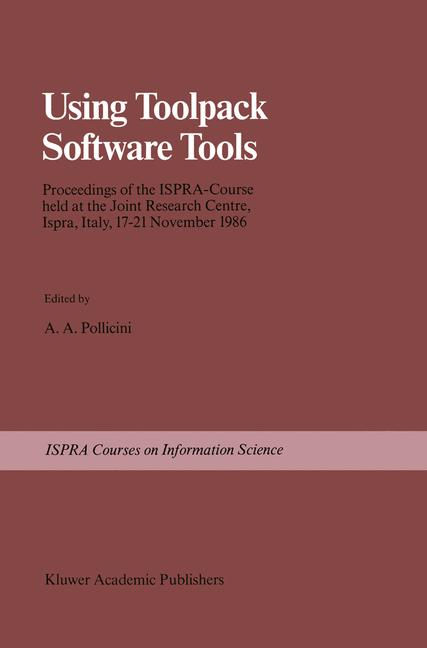
Using Toolpack Software Tools
☆☆☆☆☆
(0 opinii)
Najniższa cena (z dostawą)
7 168,00 JPY
Typowa cena362,20 PLN
Najniższa (90 dni)49,99 PLN
Liczba ofert2
Ostatnia aktualizacja13 godzin temu
| Sprzedawca | Cena produktu | Dostawa | Razem | Dostępność | Aktualizacja | |
|---|---|---|---|---|---|---|
| SP Springer Nature Author | 7 149,00 JPY | 19,00 JPY | 7 168,00 JPY | Dostępny | 13 godzin temu | Zobacz ofertę |
| SP SpringerNatureLink Shop INT | 59,00 EUR | 0 zł | 59,00 EUR | Dostępny | 1 dzień temu | Zobacz ofertę |
Ceny i dostępność mogą ulec zmianie. Ostatnia aktualizacja: 08.08.2026 23:14.
0,0
☆☆☆☆☆
0 opinii
5★
0%
4★
0%
3★
0%
2★
0%
1★
0%
Opinie o produkcie
Brak opinii — bądź pierwszy!
I am very pleased to write these few brief paragraphs introducing this book, and would like to take this opportunity to attempt to set the Toolpack project in an appropriate historical context. The Toolpack project must be considered to have actually began in the Fall of 1978, when Prof. Webb C. Miller, at a meeting at Jet Propulsion Laboratories in Pasadena, California, suggested that there be a large-scale project, called Toolpack, aimed at pulling together a comprehensive collection of mathematical software development tools. It was suggested that the project follow the pattern of other "Pack" projects, such as Eispack, Linpack, and Funpack which had assembled and systematized comprehensive collections of mathematical software in such areas as eigenvalue computation, linear equation solution and special function approximation. From the that the Toolpack project would differ significantly from beginning it was recognized these earlier "Pack" projects in that it was attempting to assemble and systematize software in an area which was not well established and understood. Thus it was not clear how to organize and integrate the tools we were to collect into Toolpack. As a consequence Toolpack became simultaneously a research project and a development project. The research was aimed at determining effective strategies for large-scale integration of large-scale software tools, and the development project was aimed at implementing these strategies and using them to put high quality tools at the disposal of working mathematical software writers.
Podobne produkty
 Patient Safety Coaching
od $91.97
Patient Safety Coaching
od $91.97
 Ethnography and Diversity
od $69.30
Ethnography and Diversity
od $69.30
 Smart Villages
od $91.97
Smart Villages
od $91.97
 Nuclear Non-Proliferation in International Law - Volume VI
od $91.97
Nuclear Non-Proliferation in International Law - Volume VI
od $91.97
 The Price of Freedom
od $91.97
The Price of Freedom
od $91.97
 Eco-Social Policy in the OECD and the World Bank
od $91.97
Eco-Social Policy in the OECD and the World Bank
od $91.97
 Special Topics in Policing
od $122.58
Special Topics in Policing
od $122.58
 Music from the Heart
od $91.97
Music from the Heart
od $91.97