
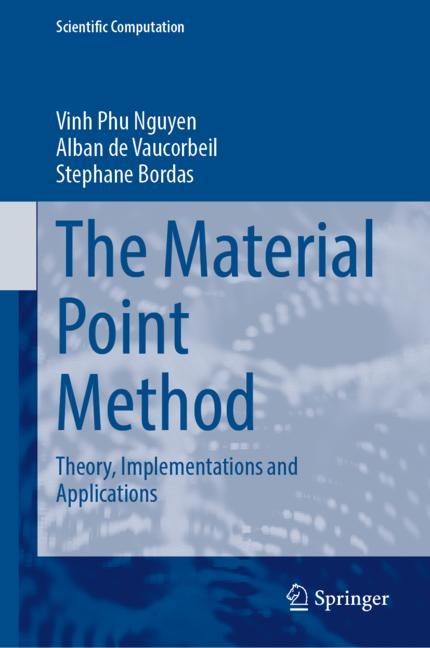
The Material Point Method
☆☆☆☆☆
(0 opinii)
Najniższa cena (z dostawą)
107,40 EUR
Typowa cena1 680,29 PLN
Najniższa (90 dni)66,85 PLN
Liczba ofert3
Ostatnia aktualizacja1 tydzień temu
Historia ceny (90 dni)
Pełna historia
2026-08-08
2026-08-15
| Zaktualizowano | Cena |
|---|---|
| 2026-08-08 | 66,85 |
| 2026-08-15 | 92,40 |
| Sprzedawca | Cena produktu | Dostawa | Razem | Dostępność | Aktualizacja | |
|---|---|---|---|---|---|---|
| SP SpringerNatureLink Shop INT | 92,40 EUR | 15,00 EUR | 107,40 EUR | Dostępny | 4 dni temu | Zobacz ofertę |
| SP SpringerNatureLink Shop INT | 16 015,00 JPY | 29,00 JPY | 16 044,00 JPY | Dostępny | 4 dni temu | Zobacz ofertę |
| SP Springer Nature Author | 16 015,00 JPY | 25,00 JPY | 16 040,00 JPY | Dostępny | 1 tydzień temu | Zobacz ofertę |
Ceny i dostępność mogą ulec zmianie. Ostatnia aktualizacja: 08.08.2026 23:27.
EAN
9783031240706
Springer Nature
0,0
☆☆☆☆☆
0 opinii
5★
0%
4★
0%
3★
0%
2★
0%
1★
0%
Opinie o produkcie
Brak opinii — bądź pierwszy!
This book provides an introduction to the fundamental theory, practical implementation, and core and emerging applications of the material point method (MPM) and its variants. The MPM combines the advantages of both finite element analysis (FEM) and meshless/meshfree methods (MMs) by representing the material by a set of particles overlaid on a background mesh that serves as a computational scratchpad. The book shows how MPM allows a robust, accurate, and efficient simulation of a wide variety of material behaviors without requiring overly complex implementations. MPM and its variants have been shown to be successful in simulating a large number of high deformation and complicated engineering problems such as densification of foam, sea ice dynamics, landslides, and energetic device explosions, to name a few, and have recently found applications in the movie industry. It is hoped that this comprehensive exposition on MPM variants and their applications will not only provide anopportunity to re-examine previous contributions, but also to re-organize them in a coherent fashion and in anticipation of new advances. Sample algorithms for the solutions of benchmark problems are provided online so that researchers and graduate students can modify these algorithms and develop their own solution algorithms for specific problems. The goal of this book is to provide students and researchers with a theoretical and practical knowledge of the material point method to analyze engineering problems, and it may help initiate and promote further in-depth studies on the subjects discussed.
Podobne produkty
 50 Years of Philosophy and Medicine
od $107.30
50 Years of Philosophy and Medicine
od $107.30
 Understanding Cybersecurity Law and Digital Privacy
od $122.63
Understanding Cybersecurity Law and Digital Privacy
od $122.63
 Decisions in International Trade and Logistics
od $122.63
Decisions in International Trade and Logistics
od $122.63
 Advances in Economic Measurement
od $122.63
Advances in Economic Measurement
od $122.63
 Nanomaterials
od $137.96
Nanomaterials
od $137.96
 Sustainable Scaffolds-based Strategies in Tissue Engineering and Regenerative Medicine
od $162.87
Sustainable Scaffolds-based Strategies in Tissue Engineering and Regenerative Medicine
od $162.87
 Narratives in Educational Research
od $162.87
Narratives in Educational Research
od $162.87
 Environmental Biology of the Young Chinese Sturgeon
od $210.78
Environmental Biology of the Young Chinese Sturgeon
od $210.78