
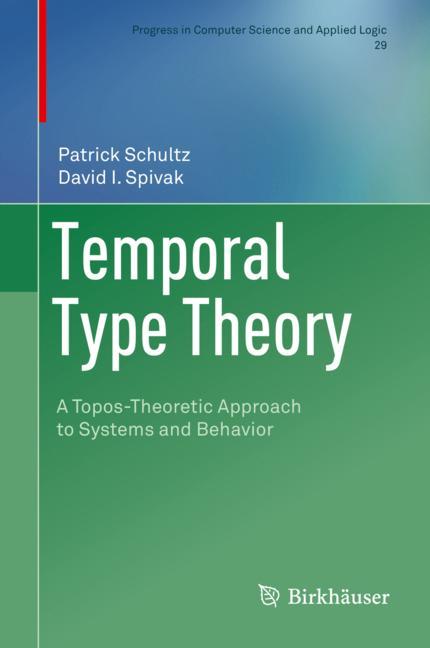
Temporal Type Theory
☆☆☆☆☆
(0 opinii)
Najniższa cena (z dostawą)
17 159,00 JPY
Typowa cena974,57 PLN
Najniższa (90 dni)87,50 PLN
Liczba ofert6
Ostatnia aktualizacja1 tydzień temu
Historia ceny (90 dni)
Pełna historia
2026-08-08
2026-08-15
| Zaktualizowano | Cena |
|---|---|
| 2026-08-08 | 87,50 |
| 2026-08-15 | 87,50 |
| Sprzedawca | Cena produktu | Dostawa | Razem | Dostępność | Aktualizacja | |
|---|---|---|---|---|---|---|
| SP SpringerNatureLink Shop INT | 17 159,00 JPY | 0 zł | 17 159,00 JPY | Dostępny | 6 dni temu | Zobacz ofertę |
| SP Springer Nature Author | 17 159,00 JPY | 15,00 JPY | 17 174,00 JPY | Dostępny | 1 tydzień temu | Zobacz ofertę |
| SP SpringerNatureLink Shop INT | 119,99 USD | 19,00 USD | 138,99 USD | Dostępny | 6 dni temu | Zobacz ofertę |
| SP SpringerNatureLink Shop INT | 129,99 USD | 0 zł | 129,99 USD | Dostępny | 6 dni temu | Zobacz ofertę |
| SP SpringerNatureLink Shop INT | 129,99 USD | 19,00 USD | 148,99 USD | Dostępny | 6 dni temu | Zobacz ofertę |
| SP SpringerNatureLink Shop INT | 142,00 EUR | 25,00 EUR | 167,00 EUR | Dostępny | 6 dni temu | Zobacz ofertę |
Ceny i dostępność mogą ulec zmianie. Ostatnia aktualizacja: 08.08.2026 22:18.
0,0
☆☆☆☆☆
0 opinii
5★
0%
4★
0%
3★
0%
2★
0%
1★
0%
Opinie o produkcie
Brak opinii — bądź pierwszy!
This innovative monograph explores a new mathematical formalism in higher-order temporal logic for proving properties about the behavior of systems. Developed by the authors, the goal of this novel approach is to explain what occurs when multiple, distinct system components interact by using a category-theoretic description of behavior types based on sheaves. The authors demonstrate how to analyze the behaviors of elements in continuous and discrete dynamical systems so that each can be translated and compared to one another. Their temporal logic is also flexible enough that it can serve as a framework for other logics that work with similar models. The book begins with a discussion of behavior types, interval domains, and translation invariance, which serves as the groundwork for temporal type theory. From there, the authors lay out the logical preliminaries they need for their temporal modalities and explain the soundness of those logical semantics. These results are then applied to hybrid dynamical systems, differential equations, and labeled transition systems. A case study involving aircraft separation within the National Airspace System is provided to illustrate temporal type theory in action. Researchers in computer science, logic, and mathematics interested in topos-theoretic and category-theory-friendly approaches to system behavior will find this monograph to be an important resource. It can also serve as a supplemental text for a specialized graduate topics course.
Podobne produkty
 50 Years of Philosophy and Medicine
od $107.30
50 Years of Philosophy and Medicine
od $107.30
 Understanding Cybersecurity Law and Digital Privacy
od $122.63
Understanding Cybersecurity Law and Digital Privacy
od $122.63
 Decisions in International Trade and Logistics
od $122.63
Decisions in International Trade and Logistics
od $122.63
 Advances in Economic Measurement
od $122.63
Advances in Economic Measurement
od $122.63
 Nanomaterials
od $137.96
Nanomaterials
od $137.96
 Sustainable Scaffolds-based Strategies in Tissue Engineering and Regenerative Medicine
od $162.87
Sustainable Scaffolds-based Strategies in Tissue Engineering and Regenerative Medicine
od $162.87
 Narratives in Educational Research
od $162.87
Narratives in Educational Research
od $162.87
 Environmental Biology of the Young Chinese Sturgeon
od $210.78
Environmental Biology of the Young Chinese Sturgeon
od $210.78