
SIMPLE-G
☆☆☆☆☆
(0 opinii)
Najniższa cena (z dostawą)
91,68 EUR
Typowa cena66,68 PLN
Najniższa (90 dni)66,68 PLN
Liczba ofert2
Ostatnia aktualizacja1 tydzień temu
| Sprzedawca | Cena produktu | Dostawa | Razem | Dostępność | Aktualizacja | |
|---|---|---|---|---|---|---|
| SP SpringerNatureLink Shop INT | 66,68 EUR | 25,00 EUR | 91,68 EUR | Dostępny | 5 dni temu | Zobacz ofertę |
| SP Springer Nature Author | 66,68 EUR | 15,00 EUR | 81,68 EUR | Dostępny | 1 tydzień temu | Zobacz ofertę |
Ceny i dostępność mogą ulec zmianie. Ostatnia aktualizacja: 08.08.2026 11:48.
EAN
9783031680533
Springer Nature
0,0
☆☆☆☆☆
0 opinii
5★
0%
4★
0%
3★
0%
2★
0%
1★
0%
Opinie o produkcie
Brak opinii — bądź pierwszy!
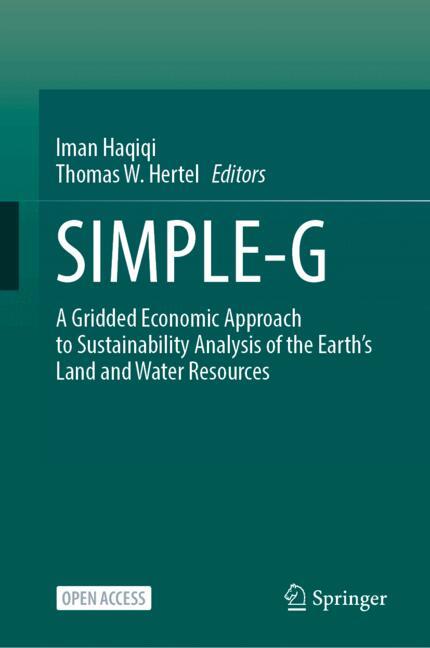
This is an open access book. Crafted for both the economist and the curious mind, this book introduces a novel approach to blending economic and biophysical sciences to enable multi-scale analysis of a range of sustainability challenges confronting the world’s land and water resources at both local and global scales. It focuses specifically on the interface between the environment and food systems, utilizing economic theory to structure the overall framework. However, within the SIMPLE-G framework, there is ample room to incorporate fine-scale biophysical knowledge from agronomy, climate science, ecology, geography, hydrology, as well as a range of socioeconomic considerations. This enables multi-scale analyses incorporating grid cells that can vary in size from 250 meters to sub-regional scales. This, in turn, allows for investigation of global change drivers’ impacts on local sustainability, as well as feedbacks from local sustainability policies to regional and global outcomes. The book opens with a foreword by a prominent sustainability scientist, Prof. Navin Ramankutty, and proceeds in five parts covering, respectively: (1) introduction and overview, (2) basic economic theory underpinning SIMPLE-G, (3) the SIMPLE-G framework, including structure, data, parameters, computer implementation, and validation, (4) eight diverse applications of the SIMPLE-G framework, covering a range of geographies and sustainability challenges, and (5) a forward-looking chapter on future directions. The book provides step-by-step guidance on building and utilizing gridded models with real-world case studies demonstrating practical applications which will facilitate its use by academics, practitioners, and students conducting research on climate impacts, land-use, water resource management, food security, poverty, equity, nutritional outcomes, and overall sustainability.
Podobne produkty
 50 Years of Philosophy and Medicine
od $107.30
50 Years of Philosophy and Medicine
od $107.30
 Understanding Cybersecurity Law and Digital Privacy
od $122.63
Understanding Cybersecurity Law and Digital Privacy
od $122.63
 Decisions in International Trade and Logistics
od $122.63
Decisions in International Trade and Logistics
od $122.63
 Advances in Economic Measurement
od $122.63
Advances in Economic Measurement
od $122.63
 Nanomaterials
od $137.96
Nanomaterials
od $137.96
 Sustainable Scaffolds-based Strategies in Tissue Engineering and Regenerative Medicine
od $162.87
Sustainable Scaffolds-based Strategies in Tissue Engineering and Regenerative Medicine
od $162.87
 Narratives in Educational Research
od $162.87
Narratives in Educational Research
od $162.87
 Environmental Biology of the Young Chinese Sturgeon
od $210.78
Environmental Biology of the Young Chinese Sturgeon
od $210.78