
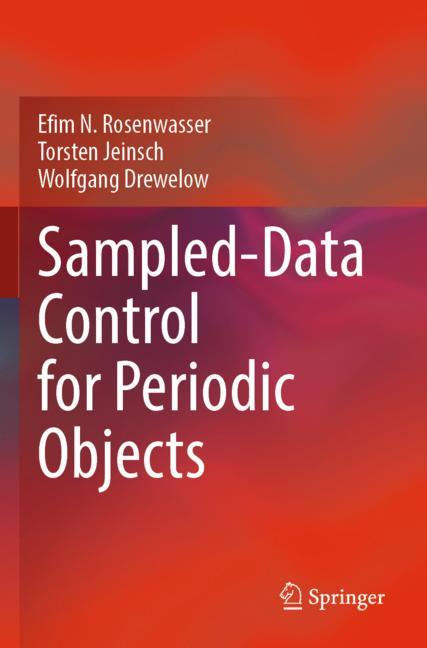
Sampled-Data Control for Periodic Objects
☆☆☆☆☆
(0 opinii)
Najniższa cena (z dostawą)
103,50 GBP
Typowa cena3 129,87 PLN
Najniższa (90 dni)117,69 PLN
Liczba ofert2
Ostatnia aktualizacja5 dni temu
| Sprzedawca | Cena produktu | Dostawa | Razem | Dostępność | Aktualizacja | |
|---|---|---|---|---|---|---|
| SP SpringerNatureLink Shop INT | 103,50 GBP | 0 zł | 103,50 GBP | Dostępny | 5 dni temu | Zobacz ofertę |
| SP Springer Nature Author | 21 449,00 JPY | 0 zł | 21 449,00 JPY | Dostępny | 5 dni temu | Zobacz ofertę |
Ceny i dostępność mogą ulec zmianie. Ostatnia aktualizacja: 08.08.2026 23:28.
0,0
☆☆☆☆☆
0 opinii
5★
0%
4★
0%
3★
0%
2★
0%
1★
0%
Opinie o produkcie
Brak opinii — bądź pierwszy!
This book is devoted to the problem of sampled-data control of finite-dimensional linear continuous periodic (FDLCP) objects. It fills a deficit in coverage of this important subject. The methods presented here are based on the parametric transfer matrix, which has proven successful in the study of sampled-data systems with linear time-invariant objects. The book shows that this concept can be successfully transferred to sampled-data systems with FDLCP objects. It is set out in five parts: · · an introduction to the frequency approach for the mathematical description of FDLCP objects including the determination of their structure and their representation as a serial connection of periodic modulators and a linear time-invariant object; · construction of parametric transfer matrix for different types of open and closed sampled-data systems with FDLCP objects; · the solution of problems of causal modal control of FDLCP objects based on the mathematical apparatus of determinant polynomial equations; · consideration of the problem of constructing a quadratic quality functional for the H2-optimization problem of a single-loop synchronous sampled-data system with control delay; · description of the general H2-optimization procedure. Necessary mathematical reference material is included at relevant points in the book. Sampled-Data Control for Periodic Objects is of use to: scientists and engineers involved in research and design of systems of systems with FDLCP objects; graduate students wishing to broaden their scope of competence; their instructors; and mathematicians working in thefield of control theory.
Podobne produkty
 Patient Safety Coaching
od $91.97
Patient Safety Coaching
od $91.97
 Ethnography and Diversity
od $69.30
Ethnography and Diversity
od $69.30
 Smart Villages
od $91.97
Smart Villages
od $91.97
 Nuclear Non-Proliferation in International Law - Volume VI
od $91.97
Nuclear Non-Proliferation in International Law - Volume VI
od $91.97
 The Price of Freedom
od $91.97
The Price of Freedom
od $91.97
 Eco-Social Policy in the OECD and the World Bank
od $91.97
Eco-Social Policy in the OECD and the World Bank
od $91.97
 Special Topics in Policing
od $122.58
Special Topics in Policing
od $122.58
 Music from the Heart
od $91.97
Music from the Heart
od $91.97