
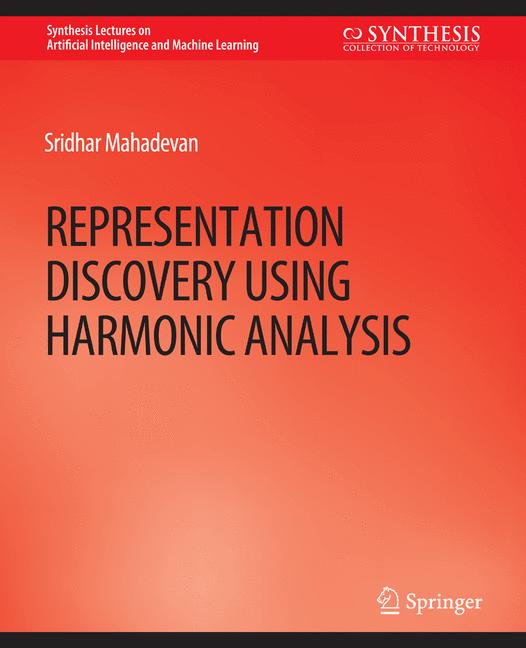
Representation Discovery using Harmonic Analysis
☆☆☆☆☆
(0 opinii)
Najniższa cena (z dostawą)
4 733,00 JPY
Typowa cena185,49 PLN
Najniższa (90 dni)9,90 PLN
Liczba ofert3
Ostatnia aktualizacja1 dzień temu
Historia ceny (90 dni)
Pełna historia
2026-08-07
2026-08-08
| Zaktualizowano | Cena |
|---|---|
| 2026-08-07 | 9,90 |
| 2026-08-08 | 34,31 |
| Sprzedawca | Cena produktu | Dostawa | Razem | Dostępność | Aktualizacja | |
|---|---|---|---|---|---|---|
| SP Springer Nature Author | 4 718,00 JPY | 15,00 JPY | 4 733,00 JPY | Dostępny | 1 dzień temu | Zobacz ofertę |
| SP SpringerNatureLink Shop INT | 39,00 EUR | 29,00 EUR | 68,00 EUR | Dostępny | 1 dzień temu | Zobacz ofertę |
| VI VitalSource | 199,24 ZAR | 0 zł | 199,24 ZAR | Dostępny | 1 dzień temu | Zobacz ofertę |
Ceny i dostępność mogą ulec zmianie. Ostatnia aktualizacja: 08.08.2026 05:21.
EAN
9783031004186
Springer Nature
0,0
☆☆☆☆☆
0 opinii
5★
0%
4★
0%
3★
0%
2★
0%
1★
0%
Opinie o produkcie
Brak opinii — bądź pierwszy!
Representations are at the heart of artificial intelligence (AI). This book is devoted to the problem of representation discovery: how can an intelligent system construct representations from its experience? Representation discovery re-parameterizes the state space - prior to the application of information retrieval, machine learning, or optimization techniques - facilitating later inference processes by constructing new task-specific bases adapted to the state space geometry. This book presents a general approach to representation discovery using the framework of harmonic analysis, in particular Fourier and wavelet analysis. Biometric compression methods, the compact disc, the computerized axial tomography (CAT) scanner in medicine, JPEG compression, and spectral analysis of time-series data are among the many applications of classical Fourier and wavelet analysis. A central goal of this book is to show that these analytical tools can be generalized from their usual setting in (infinite-dimensional) Euclidean spaces to discrete (finite-dimensional) spaces typically studied in many subfields of AI. Generalizing harmonic analysis to discrete spaces poses many challenges: a discrete representation of the space must be adaptively acquired; basis functions are not pre-defined, but rather must be constructed. Algorithms for efficiently computing and representing bases require dealing with the curse of dimensionality. However, the benefits can outweigh the costs, since the extracted basis functions outperform parametric bases as they often reflect the irregular shape of a particular state space. Case studies from computer graphics, information retrieval, machine learning, and state space planning are used to illustrate the benefits of the proposed framework, and the challenges that remain to be addressed. Representation discovery is an actively developing field, and the author hopes this book will encourage other researchers to explore this exciting area of research. Table of Contents: Overview / Vector Spaces / Fourier Bases on Graphs / Multiscale Bases on Graphs / Scaling to Large Spaces / Case Study: State-Space Planning / Case Study: Computer Graphics / Case Study: Natural Language / Future Directions
Podobne produkty
 Patient Safety Coaching
od $91.97
Patient Safety Coaching
od $91.97
 Ethnography and Diversity
od $69.30
Ethnography and Diversity
od $69.30
 Smart Villages
od $91.97
Smart Villages
od $91.97
 Nuclear Non-Proliferation in International Law - Volume VI
od $91.97
Nuclear Non-Proliferation in International Law - Volume VI
od $91.97
 The Price of Freedom
od $91.97
The Price of Freedom
od $91.97
 Eco-Social Policy in the OECD and the World Bank
od $91.97
Eco-Social Policy in the OECD and the World Bank
od $91.97
 Special Topics in Policing
od $122.58
Special Topics in Policing
od $122.58
 Music from the Heart
od $91.97
Music from the Heart
od $91.97