
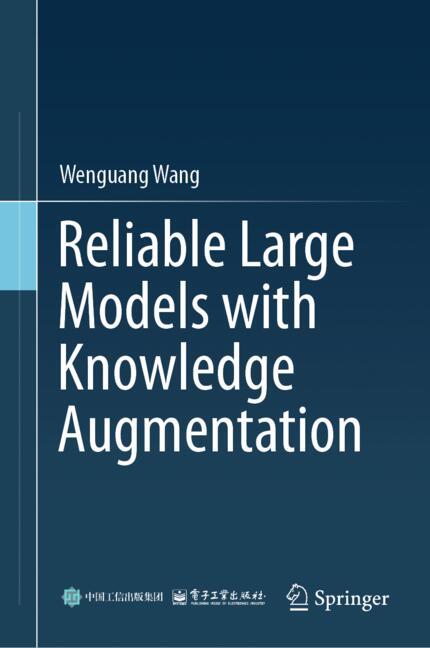
Reliable Large Models with Knowledge Augmentation
☆☆☆☆☆
(0 opinii)
Najniższa cena (z dostawą)
10 749,00 JPY
Typowa cena82,96 PLN
Najniższa (90 dni)79,11 PLN
Liczba ofert2
Ostatnia aktualizacja4 dni temu
| Sprzedawca | Cena produktu | Dostawa | Razem | Dostępność | Aktualizacja | |
|---|---|---|---|---|---|---|
| SP SpringerNatureLink Shop INT | 10 724,00 JPY | 25,00 JPY | 10 749,00 JPY | Dostępny | 4 dni temu | Zobacz ofertę |
| SP SpringerNatureLink Shop INT | 88,50 EUR | 19,00 EUR | 107,50 EUR | Dostępny | 4 dni temu | Zobacz ofertę |
Ceny i dostępność mogą ulec zmianie. Ostatnia aktualizacja: 15.08.2026 07:56.
EAN
9789819573455
Springer Nature
0,0
☆☆☆☆☆
0 opinii
5★
0%
4★
0%
3★
0%
2★
0%
1★
0%
Opinie o produkcie
Brak opinii — bądź pierwszy!
In the rapidly evolving landscape of artificial intelligence, large language models (LLMs) have emerged as transformative tools, yet they face persistent challenges such as hallucination, knowledge obsolescence, and limited reasoning depth. The book "Knowledge-Enhanced Large Models" addresses these gaps head-on, offering a comprehensive roadmap for integrating structured knowledge systems—particularly knowledge graphs—with cutting-edge AI models to build more reliable, accurate, and context-aware intelligent systems. This book is tailored for AI researchers, data scientists, engineers, students, and practitioners seeking to harness the synergy between large models and knowledge representation technologies. It balances theoretical rigor with practical implementation, making it equally valuable for academic exploration and industrial application. The book is organized into 10 chapters, systematically guiding readers from foundational concepts to advanced techniques and real-world applications. The first two chapters explore the rise of LLMs, their inherent limitations, and the paradigm shift toward knowledge-enhanced models. Chapters 3 to 5 delve into the infrastructure required to augment LLMs with structured knowledge. Chapters 6 to 9 explore cutting-edge methodologies for bridging symbolic knowledge systems with neural networks. The final chapter translates theory into practice, offering actionable guidelines for deploying knowledge-enhanced models across industries.
Podobne produkty
 50 Years of Philosophy and Medicine
od $107.30
50 Years of Philosophy and Medicine
od $107.30
 Understanding Cybersecurity Law and Digital Privacy
od $122.63
Understanding Cybersecurity Law and Digital Privacy
od $122.63
 Decisions in International Trade and Logistics
od $122.63
Decisions in International Trade and Logistics
od $122.63
 Advances in Economic Measurement
od $122.63
Advances in Economic Measurement
od $122.63
 Nanomaterials
od $137.96
Nanomaterials
od $137.96
 Sustainable Scaffolds-based Strategies in Tissue Engineering and Regenerative Medicine
od $162.87
Sustainable Scaffolds-based Strategies in Tissue Engineering and Regenerative Medicine
od $162.87
 Narratives in Educational Research
od $162.87
Narratives in Educational Research
od $162.87
 Environmental Biology of the Young Chinese Sturgeon
od $210.78
Environmental Biology of the Young Chinese Sturgeon
od $210.78