
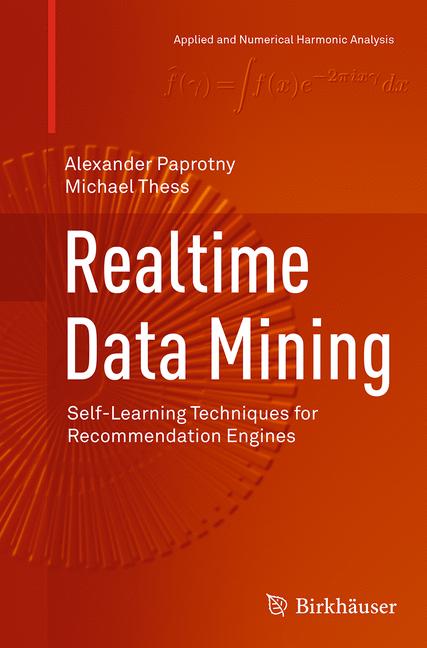
Realtime Data Mining
☆☆☆☆☆
(0 opinii)
Najniższa cena (z dostawą)
14 318,00 JPY
Typowa cena658,93 PLN
Najniższa (90 dni)84,99 PLN
Liczba ofert2
Ostatnia aktualizacja22 godziny temu
| Sprzedawca | Cena produktu | Dostawa | Razem | Dostępność | Aktualizacja | |
|---|---|---|---|---|---|---|
| SP Springer Nature Author | 14 299,00 JPY | 19,00 JPY | 14 318,00 JPY | Dostępny | 22 godziny temu | Zobacz ofertę |
| SP SpringerNatureLink Shop INT | 109,99 USD | 15,00 USD | 124,99 USD | Dostępny | 1 dzień temu | Zobacz ofertę |
Ceny i dostępność mogą ulec zmianie. Ostatnia aktualizacja: 08.08.2026 23:20.
0,0
☆☆☆☆☆
0 opinii
5★
0%
4★
0%
3★
0%
2★
0%
1★
0%
Opinie o produkcie
Brak opinii — bądź pierwszy!
Describing novel mathematical concepts for recommendation engines, Realtime Data Mining: Self-Learning Techniques for Recommendation Engines features a sound mathematical framework unifying approaches based on control and learning theories, tensor factorization, and hierarchical methods. Furthermore, it presents promising results of numerous experiments on real-world data. The area of realtime data mining is currently developing at an exceptionally dynamic pace, and realtime data mining systems are the counterpart of today's “classic” data mining systems. Whereas the latter learn from historical data and then use it to deduce necessary actions, realtime analytics systems learn and act continuously and autonomously. In the vanguard of these new analytics systems are recommendation engines. They are principally found on the Internet, where all information is available in realtime and an immediate feedback is guaranteed. This monograph appeals to computer scientists and specialists in machine learning, especially from the area of recommender systems, because it conveys a new way of realtime thinking by considering recommendation tasks as control-theoretic problems. Realtime Data Mining: Self-Learning Techniques for Recommendation Engines will also interest application-oriented mathematicians because it consistently combines some of the most promising mathematical areas, namely control theory, multilevel approximation, and tensor factorization.
Podobne produkty
 Patient Safety Coaching
od $91.97
Patient Safety Coaching
od $91.97
 Ethnography and Diversity
od $69.30
Ethnography and Diversity
od $69.30
 Smart Villages
od $91.97
Smart Villages
od $91.97
 Nuclear Non-Proliferation in International Law - Volume VI
od $91.97
Nuclear Non-Proliferation in International Law - Volume VI
od $91.97
 The Price of Freedom
od $91.97
The Price of Freedom
od $91.97
 Eco-Social Policy in the OECD and the World Bank
od $91.97
Eco-Social Policy in the OECD and the World Bank
od $91.97
 Special Topics in Policing
od $122.58
Special Topics in Policing
od $122.58
 Music from the Heart
od $91.97
Music from the Heart
od $91.97