
Quantum Photonics
☆☆☆☆☆
(0 opinii)
Najniższa cena (z dostawą)
9 151,00 JPY
Typowa cena1 579,96 PLN
Najniższa (90 dni)55,99 PLN
Liczba ofert3
Ostatnia aktualizacja1 tydzień temu
Historia ceny (90 dni)
Pełna historia
2026-08-08
2026-08-15
| Zaktualizowano | Cena |
|---|---|
| 2026-08-08 | 55,99 |
| 2026-08-15 | 55,99 |
| Sprzedawca | Cena produktu | Dostawa | Razem | Dostępność | Aktualizacja | |
|---|---|---|---|---|---|---|
| SP SpringerNatureLink Shop INT | 9 151,00 JPY | 0 zł | 9 151,00 JPY | Dostępny | 6 dni temu | Zobacz ofertę |
| SP Springer Nature Author | 9 151,00 JPY | 19,00 JPY | 9 170,00 JPY | Dostępny | 1 tydzień temu | Zobacz ofertę |
| SP SpringerNatureLink Shop INT | 75,50 EUR | 0 zł | 75,50 EUR | Dostępny | 6 dni temu | Zobacz ofertę |
Ceny i dostępność mogą ulec zmianie. Ostatnia aktualizacja: 08.08.2026 23:18.
EAN
9783031891212
Springer Nature
0,0
☆☆☆☆☆
0 opinii
5★
0%
4★
0%
3★
0%
2★
0%
1★
0%
Opinie o produkcie
Brak opinii — bądź pierwszy!
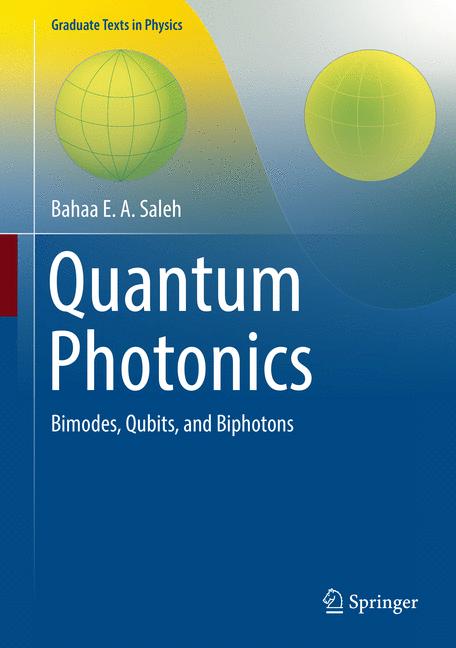
This book introduces classical modal optics and discrete quantum systems using a common mathematical approach based on linear vector spaces. It explores the three key elements of photonic quantum information: the optical bimode, the qubit, and the photon. Both the bimode and qubit are represented as vectors in a two-dimensional linear vector space, but the qubit distinguishes itself through unique properties linked to quantum measurement. While optical bimodes can be mutually coupled, qubits can be entangled, enabling revolutionary quantum information technologies. A single photon occupying a bimode encodes a qubit, facilitating cryptographic protocols for secure communication. When occupying two bimodes, a photon encodes two qubits, enabling local gates. A photon distributed across spatial modes encodes an image. Entangled photon pairs form two qubits, enabling quantum-state teleportation and quantum networks. Additionally, two photons with spatiotemporal modal entanglement form a biphoton, useful for quantum sensing and imaging with sensitivity surpassing classical limits. With numerous illustrations, examples, and exercises, the book is ideal for classroom teaching or self-study at the upper-level undergraduate or beginning graduate level. It also serves as an accessible introduction for readers interested in the foundational principles driving the second quantum revolution and its diverse applications in communication, computing, and metrology.
Podobne produkty
 50 Years of Philosophy and Medicine
od $107.30
50 Years of Philosophy and Medicine
od $107.30
 Understanding Cybersecurity Law and Digital Privacy
od $122.63
Understanding Cybersecurity Law and Digital Privacy
od $122.63
 Decisions in International Trade and Logistics
od $122.63
Decisions in International Trade and Logistics
od $122.63
 Advances in Economic Measurement
od $122.63
Advances in Economic Measurement
od $122.63
 Nanomaterials
od $137.96
Nanomaterials
od $137.96
 Sustainable Scaffolds-based Strategies in Tissue Engineering and Regenerative Medicine
od $162.87
Sustainable Scaffolds-based Strategies in Tissue Engineering and Regenerative Medicine
od $162.87
 Narratives in Educational Research
od $162.87
Narratives in Educational Research
od $162.87
 Environmental Biology of the Young Chinese Sturgeon
od $210.78
Environmental Biology of the Young Chinese Sturgeon
od $210.78