
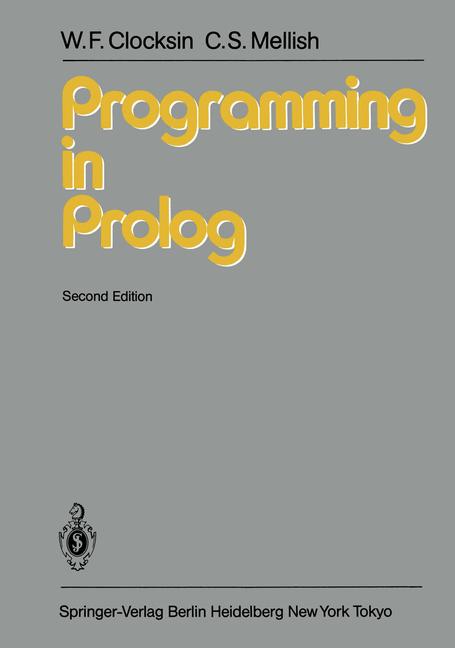
Programming in Prolog
☆☆☆☆☆
(0 opinii)
Najniższa cena (z dostawą)
9 171,00 JPY
Typowa cena3 105,33 PLN
Najniższa (90 dni)85,00 PLN
Liczba ofert2
Ostatnia aktualizacja3 dni temu
| Sprzedawca | Cena produktu | Dostawa | Razem | Dostępność | Aktualizacja | |
|---|---|---|---|---|---|---|
| SP Springer Nature Author | 9 146,00 JPY | 25,00 JPY | 9 171,00 JPY | Dostępny | 3 dni temu | Zobacz ofertę |
| SP SpringerNatureLink Shop INT | 85,00 EUR | 15,00 EUR | 100,00 EUR | Dostępny | 3 dni temu | Zobacz ofertę |
Ceny i dostępność mogą ulec zmianie. Ostatnia aktualizacja: 08.08.2026 23:18.
EAN
9783642968730
Springer Nature
0,0
☆☆☆☆☆
0 opinii
5★
0%
4★
0%
3★
0%
2★
0%
1★
0%
Opinie o produkcie
Brak opinii — bądź pierwszy!
Since the first publishing of Programming in Prolog in 1981, Pro log has continued to attract an unexpectedly great deal of interest in the computer science community and is now seen as a potential ba sis for an important new generation of programming languages and systems. We hope that Programming in Prolog has partially satisfied the increasing need for an easy, yet comprehensive introduction to the language as a tool for practical programming. In this second edition we have taken the opportunity to improve the presentation and to correct various minor errors in the original. We thank the many people who have given us suggestions for corrections and improvement. W. F. C. C. S. M. Cambridge, England August, 198-1 Preface to the First Edition The computer programming language Prolog is quickly gaining popularity throughout the world. Since its beginnings around 1970, Prolog has been chosen by many programmers for applications of symbolic computation, including: • relational databases • mathematical logic • abstract problem solving • understanding naturallangur~ge • design automation • symbolic equation solving • biochemical structure analysis • many areas of artificial intelligence Until now, there has been no textbook with the aim of teaching Prolog as a practical programming language. It is perhaps a tribute to Prolog that so many people have been motivated to learn it by referring to the necessarily concise reference manuals, a few published papers, and by the orally transmitted 'folklore' of the modern computing community.
Podobne produkty
 Patient Safety Coaching
od $91.97
Patient Safety Coaching
od $91.97
 Ethnography and Diversity
od $69.30
Ethnography and Diversity
od $69.30
 Smart Villages
od $91.97
Smart Villages
od $91.97
 Nuclear Non-Proliferation in International Law - Volume VI
od $91.97
Nuclear Non-Proliferation in International Law - Volume VI
od $91.97
 The Price of Freedom
od $91.97
The Price of Freedom
od $91.97
 Eco-Social Policy in the OECD and the World Bank
od $91.97
Eco-Social Policy in the OECD and the World Bank
od $91.97
 Special Topics in Policing
od $122.58
Special Topics in Policing
od $122.58
 Music from the Heart
od $91.97
Music from the Heart
od $91.97