
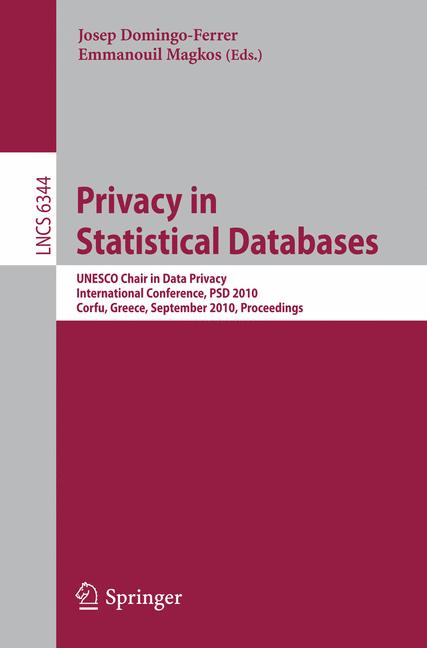
Privacy in Statistical Databases
☆☆☆☆☆
(0 opinii)
Najniższa cena (z dostawą)
8 598,00 JPY
Typowa cena677,19 PLN
Najniższa (90 dni)53,99 PLN
Liczba ofert3
Ostatnia aktualizacja1 tydzień temu
Historia ceny (90 dni)
Pełna historia
2026-08-08
2026-08-15
| Zaktualizowano | Cena |
|---|---|
| 2026-08-08 | 64,19 |
| 2026-08-15 | 53,99 |
| Sprzedawca | Cena produktu | Dostawa | Razem | Dostępność | Aktualizacja | |
|---|---|---|---|---|---|---|
| SP SpringerNatureLink Shop INT | 8 579,00 JPY | 19,00 JPY | 8 598,00 JPY | Dostępny | 1 tydzień temu | Zobacz ofertę |
| SP Springer Nature Author | 8 579,00 JPY | 0 zł | 8 579,00 JPY | Dostępny | 1 tydzień temu | Zobacz ofertę |
| SP SpringerNatureLink Shop INT | 80,00 EUR | 0 zł | 80,00 EUR | Dostępny | 1 tydzień temu | Zobacz ofertę |
Ceny i dostępność mogą ulec zmianie. Ostatnia aktualizacja: 08.08.2026 23:17.
EAN
9783642158384
Springer Nature
0,0
☆☆☆☆☆
0 opinii
5★
0%
4★
0%
3★
0%
2★
0%
1★
0%
Opinie o produkcie
Brak opinii — bądź pierwszy!
Privacy in statistical databases is a discipline whose purpose is to provide so- tionstothetensionbetweenthesocial,political,economicandcorporatedemand for accurate information, and the legal and ethical obligation to protect the p- vacy of the various parties involved. Those parties are the respondents (the individuals and enterprises to which the database records refer), the data o- ers (those organizations spending money in data collection) and the users (the ones querying the database or the search engine, who would like their queries to stay con?dential). Beyond law and ethics, there are also practical reasons for data-collecting agencies and corporations to invest in respondent privacy: if individual respondents feel their privacy guaranteed, they are likely to provide moreaccurateresponses. Data ownerprivacyis primarilymotivatedbypractical considerations: if an enterprise collects data at its own expense, it may wish to minimize leakage of those data to other enterprises (even to those with whom joint data exploitation is planned). Finally, user privacy results in increaseduser satisfaction, even if it may curtail the ability of the database owner to pro?le users. Thereareatleasttwotraditionsinstatisticaldatabaseprivacy,bothofwhich started in the 1970s: the ?rst one stems from o?cial statistics, where the dis- pline is also known as statistical disclosure control (SDC), and the second one originates from computer science and database technology. In o?cial statistics, the basic concern is respondent privacy. In computer science, the initial mo- vation was also respondent privacy but, from 2000 onwards, growing attention has been devoted to owner privacy (privacy-preserving data mining) and user privacy (private informationretrieval).
Podobne produkty
 50 Years of Philosophy and Medicine
od $107.30
50 Years of Philosophy and Medicine
od $107.30
 Understanding Cybersecurity Law and Digital Privacy
od $122.63
Understanding Cybersecurity Law and Digital Privacy
od $122.63
 Decisions in International Trade and Logistics
od $122.63
Decisions in International Trade and Logistics
od $122.63
 Advances in Economic Measurement
od $122.63
Advances in Economic Measurement
od $122.63
 Nanomaterials
od $137.96
Nanomaterials
od $137.96
 Sustainable Scaffolds-based Strategies in Tissue Engineering and Regenerative Medicine
od $162.87
Sustainable Scaffolds-based Strategies in Tissue Engineering and Regenerative Medicine
od $162.87
 Narratives in Educational Research
od $162.87
Narratives in Educational Research
od $162.87
 Environmental Biology of the Young Chinese Sturgeon
od $210.78
Environmental Biology of the Young Chinese Sturgeon
od $210.78