
Physicomimetics
☆☆☆☆☆
(0 opinii)
Najniższa cena (z dostawą)
14 318,00 JPY
Typowa cena1 131,22 PLN
Najniższa (90 dni)71,50 PLN
Liczba ofert6
Ostatnia aktualizacja1 tydzień temu
Historia ceny (90 dni)
Pełna historia
2026-08-08
2026-08-15
| Zaktualizowano | Cena |
|---|---|
| 2026-08-08 | 84,99 |
| 2026-08-15 | 71,50 |
| Sprzedawca | Cena produktu | Dostawa | Razem | Dostępność | Aktualizacja | |
|---|---|---|---|---|---|---|
| SP SpringerNatureLink Shop INT | 14 299,00 JPY | 19,00 JPY | 14 318,00 JPY | Dostępny | 1 dzień temu | Zobacz ofertę |
| SP Springer Nature Author | 14 299,00 JPY | 25,00 JPY | 14 324,00 JPY | Dostępny | 1 tydzień temu | Zobacz ofertę |
| SP SpringerNatureLink Shop INT | 99,99 USD | 0 zł | 99,99 USD | Dostępny | 1 dzień temu | Zobacz ofertę |
| SP SpringerNatureLink Shop INT | 109,99 USD | 25,00 USD | 134,99 USD | Dostępny | 1 dzień temu | Zobacz ofertę |
| SP SpringerNatureLink Shop INT | 109,99 USD | 29,00 USD | 138,99 USD | Dostępny | 1 dzień temu | Zobacz ofertę |
| SP SpringerNatureLink Shop INT | 118,00 EUR | 29,00 EUR | 147,00 EUR | Dostępny | 1 dzień temu | Zobacz ofertę |
Ceny i dostępność mogą ulec zmianie. Ostatnia aktualizacja: 08.08.2026 23:21.
0,0
☆☆☆☆☆
0 opinii
5★
0%
4★
0%
3★
0%
2★
0%
1★
0%
Opinie o produkcie
Brak opinii — bądź pierwszy!
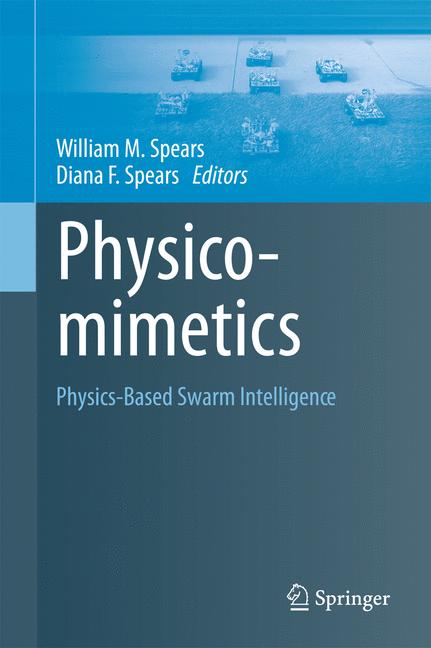
Standard approaches to understanding swarms rely on inspiration from biology and are generally covered by the term “biomimetics”. This book focuses on a different, complementary inspiration, namely physics. The editors have introduced the term 'physicomimetics' to refer to physics-based swarm approaches, which offer two advantages. First, they capture the notion that “nature is lazy', meaning that physics-based systems always perform the minimal amount of work necessary, which is an especially important advantage in swarm robotics. Second, physics is the most predictive science, and can reduce complex systems to simple concepts and equations that codify emergent behavior and help us to design and understand swarms. The editors consolidated over a decade of work on swarm intelligence and swarm robotics, organizing the book into 19 chapters as follows. Part I introduces the concept of swarms and offers the reader a physics tutorial; Part II deals with applications of physicomimetics, in order of increased complexity; Part III examines the hardware requirements of the presented algorithms and demonstrates real robot implementations; Part IV demonstrates how the theory can be used to design swarms from first principles and provides a novel algorithm that handles changing environments; finally, Part V shows that physicomimetics can be used for function optimization, moving the reader from issues of swarm robotics to swarm intelligence. The text is supported with a downloadable package containing simulation code and videos of working robots. This book is suitable for talented high school and undergraduate students, as well as researchers and graduate students in the areas of artificial intelligence and robotics.
Podobne produkty
 50 Years of Philosophy and Medicine
od $107.30
50 Years of Philosophy and Medicine
od $107.30
 Understanding Cybersecurity Law and Digital Privacy
od $122.63
Understanding Cybersecurity Law and Digital Privacy
od $122.63
 Decisions in International Trade and Logistics
od $122.63
Decisions in International Trade and Logistics
od $122.63
 Advances in Economic Measurement
od $122.63
Advances in Economic Measurement
od $122.63
 Nanomaterials
od $137.96
Nanomaterials
od $137.96
 Sustainable Scaffolds-based Strategies in Tissue Engineering and Regenerative Medicine
od $162.87
Sustainable Scaffolds-based Strategies in Tissue Engineering and Regenerative Medicine
od $162.87
 Narratives in Educational Research
od $162.87
Narratives in Educational Research
od $162.87
 Environmental Biology of the Young Chinese Sturgeon
od $210.78
Environmental Biology of the Young Chinese Sturgeon
od $210.78