
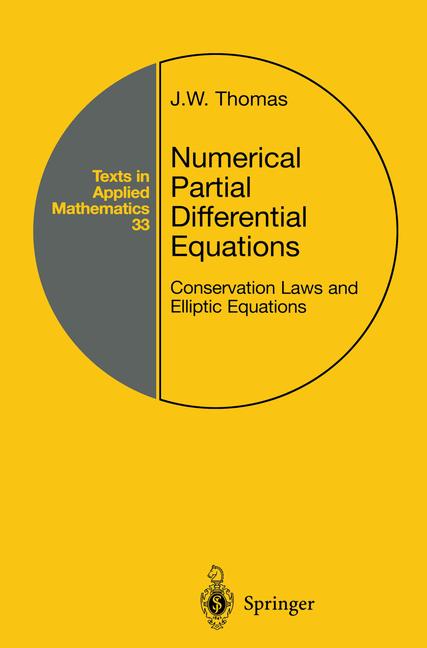
Numerical Partial Differential Equations
☆☆☆☆☆
(0 opinii)
Najniższa cena (z dostawą)
77,99 USD
Typowa cena51,19 PLN
Najniższa (90 dni)41,19 PLN
Liczba ofert6
Ostatnia aktualizacja1 tydzień temu
Historia ceny (90 dni)
Pełna historia
2026-08-08
2026-08-15
| Zaktualizowano | Cena |
|---|---|
| 2026-08-08 | 41,19 |
| 2026-08-15 | 41,19 |
| Sprzedawca | Cena produktu | Dostawa | Razem | Dostępność | Aktualizacja | |
|---|---|---|---|---|---|---|
| SP SpringerNatureLink Shop INT | 48,99 USD | 29,00 USD | 77,99 USD | Dostępny | 5 dni temu | Zobacz ofertę |
| SP SpringerNatureLink Shop INT | 48,99 USD | 19,00 USD | 67,99 USD | Dostępny | 5 dni temu | Zobacz ofertę |
| SP SpringerNatureLink Shop INT | 55,99 USD | 25,00 USD | 80,99 USD | Dostępny | 5 dni temu | Zobacz ofertę |
| SP SpringerNatureLink Shop INT | 55,99 USD | 19,00 USD | 74,99 USD | Dostępny | 5 dni temu | Zobacz ofertę |
| SP Springer Nature Author | 55,99 USD | 15,00 USD | 70,99 USD | Dostępny | 1 tydzień temu | Zobacz ofertę |
| SP SpringerNatureLink Shop INT | 76,99 EUR | 15,00 EUR | 91,99 EUR | Dostępny | 5 dni temu | Zobacz ofertę |
Ceny i dostępność mogą ulec zmianie. Ostatnia aktualizacja: 08.08.2026 11:55.
0,0
☆☆☆☆☆
0 opinii
5★
0%
4★
0%
3★
0%
2★
0%
1★
0%
Opinie o produkcie
Brak opinii — bądź pierwszy!
Of the many different approaches to solving partial differential equations numerically, this book studies difference methods. Written for the beginning graduate student in applied mathematics and engineering, this text offers a means of coming out of a course with a large number of methods that provide both theoretical knowledge and numerical experience. The reader will learn that numerical experimentation is a part of the subject of numerical solution of partial differential equations, and will be shown some uses and taught some techniques of numerical experimentation. Prerequisites suggested for using this book in a course might include at least one semester of partial differential equations and some programming capability. The author stresses the use of technology throughout the text, allowing the student to utilize it as much as possible. The use of graphics for both illustration and analysis is emphasized, and algebraic manipulators are used when convenient. This is the second volume of a two-part book.
Podobne produkty
 50 Years of Philosophy and Medicine
od $107.30
50 Years of Philosophy and Medicine
od $107.30
 Understanding Cybersecurity Law and Digital Privacy
od $122.63
Understanding Cybersecurity Law and Digital Privacy
od $122.63
 Decisions in International Trade and Logistics
od $122.63
Decisions in International Trade and Logistics
od $122.63
 Advances in Economic Measurement
od $122.63
Advances in Economic Measurement
od $122.63
 Nanomaterials
od $137.96
Nanomaterials
od $137.96
 Sustainable Scaffolds-based Strategies in Tissue Engineering and Regenerative Medicine
od $162.87
Sustainable Scaffolds-based Strategies in Tissue Engineering and Regenerative Medicine
od $162.87
 Narratives in Educational Research
od $162.87
Narratives in Educational Research
od $162.87
 Environmental Biology of the Young Chinese Sturgeon
od $210.78
Environmental Biology of the Young Chinese Sturgeon
od $210.78