
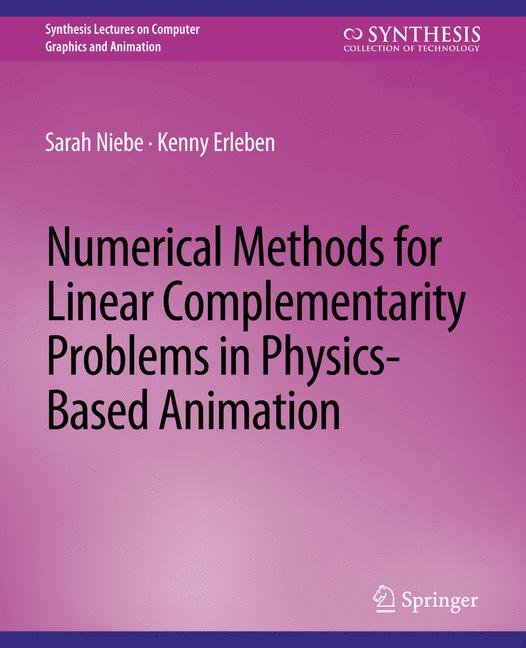
Numerical Methods for Linear Complementarity Problems in Physics-Based Animation
☆☆☆☆☆
(0 opinii)
Najniższa cena (z dostawą)
49,61 CAD
Typowa cena840,48 PLN
Najniższa (90 dni)57,19 PLN
Liczba ofert4
Ostatnia aktualizacja1 tydzień temu
Historia ceny (90 dni)
Pełna historia
2026-08-08
2026-08-15
| Zaktualizowano | Cena |
|---|---|
| 2026-08-08 | 57,19 |
| 2026-08-15 | 57,19 |
| Sprzedawca | Cena produktu | Dostawa | Razem | Dostępność | Aktualizacja | |
|---|---|---|---|---|---|---|
| VI VitalSource | 24,61 CAD | 25,00 CAD | 49,61 CAD | Dostępny | 1 tydzień temu | Zobacz ofertę |
| SP SpringerNatureLink Shop INT | 7 864,00 JPY | 25,00 JPY | 7 889,00 JPY | Dostępny | 3 dni temu | Zobacz ofertę |
| SP Springer Nature Author | 7 864,00 JPY | 0 zł | 7 864,00 JPY | Dostępny | 1 tydzień temu | Zobacz ofertę |
| SP SpringerNatureLink Shop INT | 65,00 EUR | 19,00 EUR | 84,00 EUR | Dostępny | 3 dni temu | Zobacz ofertę |
Ceny i dostępność mogą ulec zmianie. Ostatnia aktualizacja: 08.08.2026 21:10.
EAN
9783031795633
Springer Nature
0,0
☆☆☆☆☆
0 opinii
5★
0%
4★
0%
3★
0%
2★
0%
1★
0%
Opinie o produkcie
Brak opinii — bądź pierwszy!
Linear complementarity problems (LCPs) have for many years been used in physics-based animation to model contact forces between rigid bodies in contact. More recently, LCPs have found their way into the realm of fluid dynamics. Here, LCPs are used to model boundary conditions with fluid-wall contacts. LCPs have also started to appear in deformable models and granular simulations. There is an increasing need for numerical methods to solve the resulting LCPs with all these new applications. This book provides a numerical foundation for such methods, especially suited for use in computer graphics. This book is mainly intended for a researcher/Ph.D. student/post-doc/professor who wants to study the algorithms and do more work/research in this area. Programmers might have to invest some time brushing up on math skills, for this we refer to Appendices A and B. The reader should be familiar with linear algebra and differential calculus. We provide pseudo code for all the numerical methods, which should be comprehensible by any computer scientist with rudimentary programming skills. The reader can find an online supplementary code repository, containing Matlab implementations of many of the core methods covered in these notes, as well as a few Python implementations [Erleben, 2011]. Table of Contents: Introduction / Numerical Methods / Guide for Software and Selecting Methods / Bibliography / Authors' Biographies