
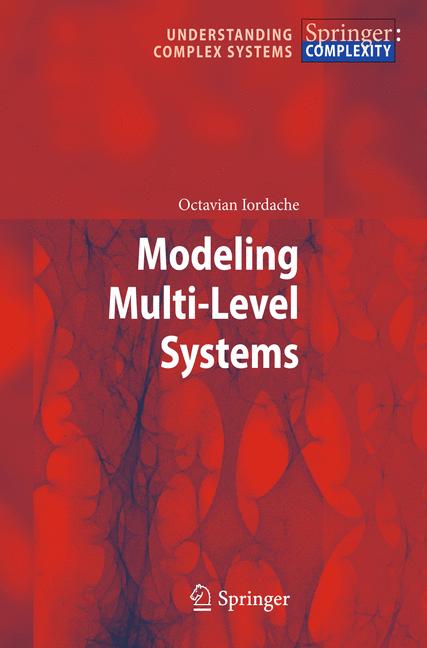
Modeling Multi-Level Systems
☆☆☆☆☆
(0 opinii)
Najniższa cena (z dostawą)
19 462,00 JPY
Typowa cena9 803,75 PLN
Najniższa (90 dni)160,50 PLN
Liczba ofert1
Ostatnia aktualizacja5 dni temu
| Sprzedawca | Cena produktu | Dostawa | Razem | Dostępność | Aktualizacja | |
|---|---|---|---|---|---|---|
| SP Springer Nature Author | 19 447,00 JPY | 15,00 JPY | 19 462,00 JPY | Dostępny | 5 dni temu | Zobacz ofertę |
Ceny i dostępność mogą ulec zmianie. Ostatnia aktualizacja: 08.08.2026 23:32.
EAN
9783642179464
Springer Nature
0,0
☆☆☆☆☆
0 opinii
5★
0%
4★
0%
3★
0%
2★
0%
1★
0%
Opinie o produkcie
Brak opinii — bądź pierwszy!
This book is devoted to modeling of multi-level complex systems, a challenging domain for engineers, researchers and entrepreneurs, confronted with the transition from learning and adaptability to evolvability and autonomy for technologies, devices and problem solving methods. Chapter 1 introduces the multi-scale and multi-level systems and highlights their presence in different domains of science and technology. Methodologies as, random systems, non-Archimedean analysis, category theory and specific techniques as model categorification and integrative closure, are presented in chapter 2. Chapters 3 and 4 describe polystochastic models, PSM, and their developments. Categorical formulation of integrative closure offers the general PSM framework which serves as a flexible guideline for a large variety of multi-level modeling problems. Focusing on chemical engineering, pharmaceutical and environmental case studies, the chapters 5 to 8 analyze mixing, turbulent dispersion and entropy production for multi-scale systems. Taking inspiration from systems sciences, chapters 9 to 11 highlight multi-level modeling potentialities in formal concept analysis, existential graphs and evolvable designs of experiments. Case studies refer to separation flow-sheets, pharmaceutical pipeline, drug design and development, reliability management systems, security and failure analysis. Perspectives and integrative points of view are discussed in chapter 12. Autonomous and viable systems, multi-agents, organic and autonomic computing, multi-level informational systems, are revealed as promising domains for future applications. Written for: engineers, researchers, entrepreneurs and students in chemical, pharmaceutical, environmental and systems sciences engineering, and for applied mathematicians.
Podobne produkty
 Gamma Knife Neurosurgery in the Management of Intracranial Disorders
od $210.78
Gamma Knife Neurosurgery in the Management of Intracranial Disorders
od $210.78
 SDGs in Construction Economics and Organization
od $210.78
SDGs in Construction Economics and Organization
od $210.78
 Emerging Therapies in Neurorehabilitation III
od $210.78
Emerging Therapies in Neurorehabilitation III
od $210.78
 Ground Improvement Techniques
od $220.36
Ground Improvement Techniques
od $220.36
 Anomaly Detection in Video Surveillance
od $220.36
Anomaly Detection in Video Surveillance
od $220.36
 Mechanism and Machine Science
od $287.42
Mechanism and Machine Science
od $287.42
 Protein-Protein Interactions as New Drug Targets
od $287.42
Protein-Protein Interactions as New Drug Targets
od $287.42
 Proceedings of the 7th International Conference of Transportation Research Group of India (CTRG 2023
od $287.42
Proceedings of the 7th International Conference of Transportation Research Group of India (CTRG 2023
od $287.42