
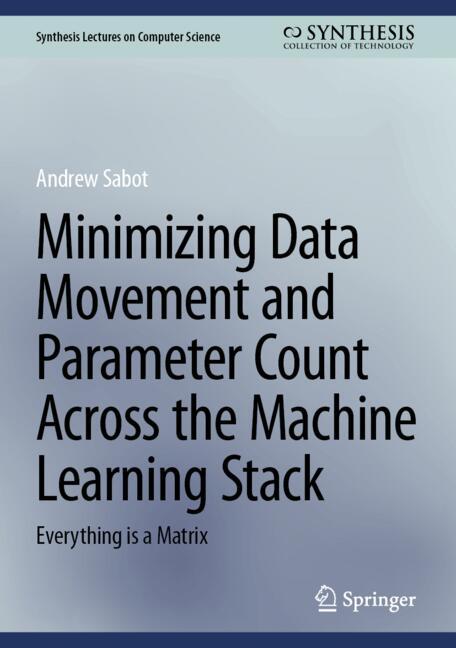
Minimizing Data Movement and Parameter Count Across the Machine Learning Stack
☆☆☆☆☆
(0 opinii)
Najniższa cena (z dostawą)
4 590,00 JPY
Typowa cena1 167,82 PLN
Najniższa (90 dni)32,09 PLN
Liczba ofert1
Ostatnia aktualizacja1 tydzień temu
| Sprzedawca | Cena produktu | Dostawa | Razem | Dostępność | Aktualizacja | |
|---|---|---|---|---|---|---|
| SP Springer Nature Author | 4 575,00 JPY | 15,00 JPY | 4 590,00 JPY | Dostępny | 1 tydzień temu | Zobacz ofertę |
Ceny i dostępność mogą ulec zmianie. Ostatnia aktualizacja: 08.08.2026 23:06.
EAN
9783032231000
Springer Nature
0,0
☆☆☆☆☆
0 opinii
5★
0%
4★
0%
3★
0%
2★
0%
1★
0%
Opinie o produkcie
Brak opinii — bądź pierwszy!
This book provides a focused, research-forward guide to making large AI models efficient in practice and also presents an array of novel techniques to reduce memory footprint, accelerate computation, and improve overall hardware utilization. The author demonstrates that substantial efficiency gains can be achieved by rethinking how data is computed, stored, and compressed, with a special focus on matrices, the core computational structure underpinning both scientific computing and neural networks. Modern AI models run on huge grids of numbers (matrices/tensors), and their speed and affordability depend on how those numbers are arranged and processed on real hardware (GPUs/TPUs/CPUs). This book explains practical methods to skip unnecessary work (structured sparsity), move data efficiently (gather/scatter), and shrink models without losing accuracy (block distillation) so that AI systems can use less memory, less time, and less energy without sacrificing quality. In addition, the book shows how to turn algorithmic ideas into hardware-aware speedups on GPUs/TPUs. Readers will learn when sparsity pays off, how to schedule irregular workloads, and how to recover accuracy in compressed models. Case studies illustrate end-to-end design choices, evaluation, and pitfalls. The result is a coherent perspective that bridges theory, compilers/run times, and real-world deployment.
Podobne produkty
 Gamma Knife Neurosurgery in the Management of Intracranial Disorders
od $210.78
Gamma Knife Neurosurgery in the Management of Intracranial Disorders
od $210.78
 SDGs in Construction Economics and Organization
od $210.78
SDGs in Construction Economics and Organization
od $210.78
 Emerging Therapies in Neurorehabilitation III
od $210.78
Emerging Therapies in Neurorehabilitation III
od $210.78
 Ground Improvement Techniques
od $220.36
Ground Improvement Techniques
od $220.36
 Anomaly Detection in Video Surveillance
od $220.36
Anomaly Detection in Video Surveillance
od $220.36
 Mechanism and Machine Science
od $287.42
Mechanism and Machine Science
od $287.42
 Protein-Protein Interactions as New Drug Targets
od $287.42
Protein-Protein Interactions as New Drug Targets
od $287.42
 Proceedings of the 7th International Conference of Transportation Research Group of India (CTRG 2023
od $287.42
Proceedings of the 7th International Conference of Transportation Research Group of India (CTRG 2023
od $287.42