
Mathematical SETI
☆☆☆☆☆
(0 opinii)
Najniższa cena (z dostawą)
18 322,00 JPY
Typowa cena6 958,00 PLN
Najniższa (90 dni)151,00 PLN
Liczba ofert3
Ostatnia aktualizacja1 tydzień temu
Historia ceny (90 dni)
Pełna historia
2026-08-08
2026-08-15
| Zaktualizowano | Cena |
|---|---|
| 2026-08-08 | 151,00 |
| 2026-08-15 | 151,00 |
| Sprzedawca | Cena produktu | Dostawa | Razem | Dostępność | Aktualizacja | |
|---|---|---|---|---|---|---|
| SP SpringerNatureLink Shop INT | 18 303,00 JPY | 19,00 JPY | 18 322,00 JPY | Dostępny | 4 dni temu | Zobacz ofertę |
| SP Springer Nature Author | 18 303,00 JPY | 29,00 JPY | 18 332,00 JPY | Dostępny | 1 tydzień temu | Zobacz ofertę |
| SP SpringerNatureLink Shop INT | 151,00 EUR | 29,00 EUR | 180,00 EUR | Dostępny | 4 dni temu | Zobacz ofertę |
Ceny i dostępność mogą ulec zmianie. Ostatnia aktualizacja: 08.08.2026 23:29.
EAN
9783642274374
Springer Nature
0,0
☆☆☆☆☆
0 opinii
5★
0%
4★
0%
3★
0%
2★
0%
1★
0%
Opinie o produkcie
Brak opinii — bądź pierwszy!
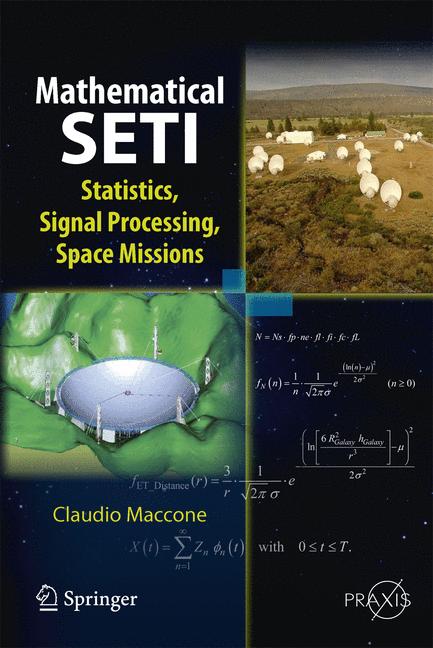
This book introduces the Statistical Drake Equation where, from a simple product of seven positive numbers, the Drake Equation is turned into the product of seven positive random variables. The mathematical consequences of this transformation are demonstrated and it is proven that the new random variable N for the number of communicating civilizations in the Galaxy must follow the lognormal probability distribution when the number of factors in the Drake equation is allowed to increase at will. Mathematical SETI also studies the proposed FOCAL (Fast Outgoing Cyclopean Astronomical Lens) space mission to the nearest Sun Focal Sphere at 550 AU and describes its consequences for future interstellar precursor missions and truly interstellar missions. In addition the author shows how SETI signal processing may be dramatically improved by use of the Karhunen-Loève Transform (KLT) rather than Fast Fourier Transform (FFT). Finally, he describes the efforts made to persuade the UnitedNations to make the central part of the Moon Far Side a UN-protected zone, in order to preserve the unique radio-noise-free environment for future scientific use.
Podobne produkty
 50 Years of Philosophy and Medicine
od $107.30
50 Years of Philosophy and Medicine
od $107.30
 Understanding Cybersecurity Law and Digital Privacy
od $122.63
Understanding Cybersecurity Law and Digital Privacy
od $122.63
 Decisions in International Trade and Logistics
od $122.63
Decisions in International Trade and Logistics
od $122.63
 Advances in Economic Measurement
od $122.63
Advances in Economic Measurement
od $122.63
 Nanomaterials
od $137.96
Nanomaterials
od $137.96
 Sustainable Scaffolds-based Strategies in Tissue Engineering and Regenerative Medicine
od $162.87
Sustainable Scaffolds-based Strategies in Tissue Engineering and Regenerative Medicine
od $162.87
 Narratives in Educational Research
od $162.87
Narratives in Educational Research
od $162.87
 Environmental Biology of the Young Chinese Sturgeon
od $210.78
Environmental Biology of the Young Chinese Sturgeon
od $210.78