
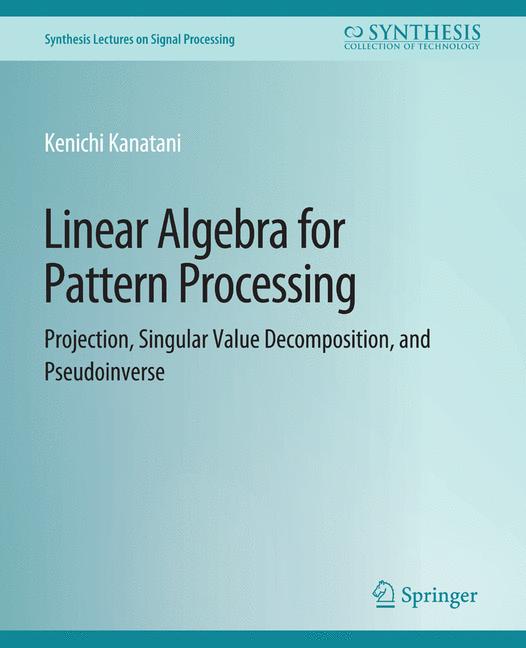
Linear Algebra for Pattern Processing
☆☆☆☆☆
(0 opinii)
Najniższa cena (z dostawą)
78,99 USD
Typowa cena58,04 PLN
Najniższa (90 dni)54,99 PLN
Liczba ofert2
Ostatnia aktualizacja14 godzin temu
| Sprzedawca | Cena produktu | Dostawa | Razem | Dostępność | Aktualizacja | |
|---|---|---|---|---|---|---|
| SP SpringerNatureLink Shop INT | 59,99 USD | 19,00 USD | 78,99 USD | Dostępny | 14 godzin temu | Zobacz ofertę |
| SP Springer Nature Author | 59,99 USD | 19,00 USD | 78,99 USD | Dostępny | 4 godziny temu | Zobacz ofertę |
Ceny i dostępność mogą ulec zmianie. Ostatnia aktualizacja: 08.08.2026 11:15.
0,0
☆☆☆☆☆
0 opinii
5★
0%
4★
0%
3★
0%
2★
0%
1★
0%
Opinie o produkcie
Brak opinii — bądź pierwszy!
Linear algebra is one of the most basic foundations of a wide range of scientific domains, and most textbooks of linear algebra are written by mathematicians. However, this book is specifically intended to students and researchers of pattern information processing, analyzing signals such as images and exploring computer vision and computer graphics applications. The author himself is a researcher of this domain. Such pattern information processing deals with a large amount of data, which are represented by high-dimensional vectors and matrices. There, the role of linear algebra is not merely numerical computation of large-scale vectors and matrices. In fact, data processing is usually accompanied with "geometric interpretation." For example, we can think of one data set being "orthogonal" to another and define a "distance" between them or invoke geometric relationships such as "projecting" some data onto some space. Such geometric concepts not only help us mentally visualize abstracthigh-dimensional spaces in intuitive terms but also lead us to find what kind of processing is appropriate for what kind of goals. First, we take up the concept of "projection" of linear spaces and describe "spectral decomposition," "singular value decomposition," and "pseudoinverse" in terms of projection. As their applications, we discuss least-squares solutions of simultaneous linear equations and covariance matrices of probability distributions of vector random variables that are not necessarily positive definite. We also discuss fitting subspaces to point data and factorizing matrices in high dimensions in relation to motion image analysis. Finally, we introduce a computer vision application of reconstructing the 3D location of a point from three camera views to illustrate the role of linear algebra in dealing with data with noise. This book is expected to help students and researchers of pattern information processing deepen the geometric understanding of linear algebra.
Podobne produkty
 Patient Safety Coaching
od $91.97
Patient Safety Coaching
od $91.97
 Ethnography and Diversity
od $69.30
Ethnography and Diversity
od $69.30
 Smart Villages
od $91.97
Smart Villages
od $91.97
 Nuclear Non-Proliferation in International Law - Volume VI
od $91.97
Nuclear Non-Proliferation in International Law - Volume VI
od $91.97
 The Price of Freedom
od $91.97
The Price of Freedom
od $91.97
 Eco-Social Policy in the OECD and the World Bank
od $91.97
Eco-Social Policy in the OECD and the World Bank
od $91.97
 Special Topics in Policing
od $122.58
Special Topics in Policing
od $122.58
 Music from the Heart
od $91.97
Music from the Heart
od $91.97