
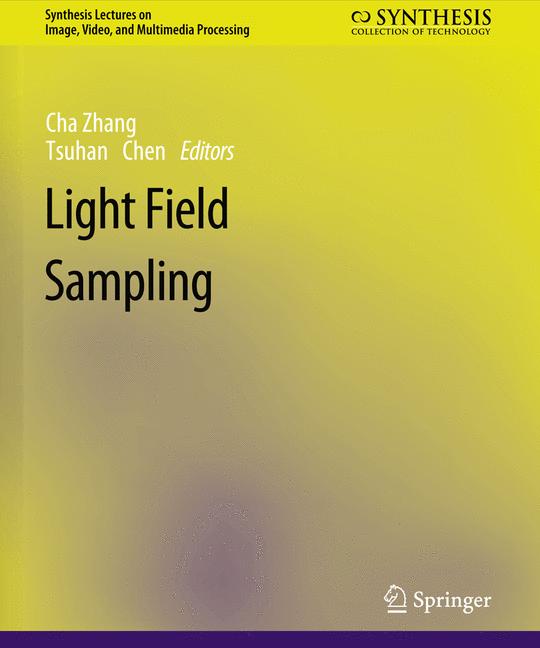
Light Field Sampling
☆☆☆☆☆
(0 opinii)
Najniższa cena (z dostawą)
3 803,00 JPY
Typowa cena184,10 PLN
Najniższa (90 dni)21,99 PLN
Liczba ofert4
Ostatnia aktualizacja1 tydzień temu
Historia ceny (90 dni)
Pełna historia
2026-08-08
2026-08-14
| Zaktualizowano | Cena |
|---|---|
| 2026-08-08 | 21,99 |
| 2026-08-14 | 26,74 |
| Sprzedawca | Cena produktu | Dostawa | Razem | Dostępność | Aktualizacja | |
|---|---|---|---|---|---|---|
| SP Springer Nature Author | 3 774,00 JPY | 29,00 JPY | 3 803,00 JPY | Dostępny | 1 tydzień temu | Zobacz ofertę |
| SP SpringerNatureLink Shop INT | 26,74 USD | 0 zł | 26,74 USD | Dostępny | 1 dzień temu | Zobacz ofertę |
| SP SpringerNatureLink Shop INT | 26,74 USD | 29,00 USD | 55,74 USD | Dostępny | 1 dzień temu | Zobacz ofertę |
| SP SpringerNatureLink Shop INT | 31,00 EUR | 0 zł | 31,00 EUR | Dostępny | 1 dzień temu | Zobacz ofertę |
Ceny i dostępność mogą ulec zmianie. Ostatnia aktualizacja: 08.08.2026 23:05.
EAN
9783031022418
Springer Nature
0,0
☆☆☆☆☆
0 opinii
5★
0%
4★
0%
3★
0%
2★
0%
1★
0%
Opinie o produkcie
Brak opinii — bądź pierwszy!
Light field is one of the most representative image-based rendering techniques that generate novel virtual views from images instead of 3D models. The light field capture and rendering process can be considered as a procedure of sampling the light rays in the space and interpolating those in novel views. As a result, light field can be studied as a high-dimensional signal sampling problem, which has attracted a lot of research interest and become a convergence point between computer graphics and signal processing, and even computer vision. This lecture focuses on answering two questions regarding light field sampling, namely how many images are needed for a light field, and if such number is limited, where we should capture them. The book can be divided into three parts. First, we give a complete analysis on uniform sampling of IBR data. By introducing the surface plenoptic function, we are able to analyze the Fourier spectrum of non-Lambertian and occluded scenes. Given the spectrum,we also apply the generalized sampling theorem on the IBR data, which results in better rendering quality than rectangular sampling for complex scenes. Such uniform sampling analysis provides general guidelines on how the images in IBR should be taken. For instance, it shows that non-Lambertian and occluded scenes often require a higher sampling rate. Next, we describe a very general sampling framework named freeform sampling. Freeform sampling handles three kinds of problems: sample reduction, minimum sampling rate to meet an error requirement, and minimization of reconstruction error given a fixed number of samples. When the to-be-reconstructed function values are unknown, freeform sampling becomes active sampling. Algorithms of active sampling are developed for light field and show better results than the traditional uniform sampling approach. Third, we present a self-reconfigurable camera array that we developed, which features a very efficient algorithm for real-time rendering andthe ability of automatically reconfiguring the cameras to improve the rendering quality. Both are based on active sampling. Our camera array is able to render dynamic scenes interactively at high quality. To the best of our knowledge, it is the first camera array that can reconfigure the camera positions automatically.
Podobne produkty
 50 Years of Philosophy and Medicine
od $107.30
50 Years of Philosophy and Medicine
od $107.30
 Understanding Cybersecurity Law and Digital Privacy
od $122.63
Understanding Cybersecurity Law and Digital Privacy
od $122.63
 Decisions in International Trade and Logistics
od $122.63
Decisions in International Trade and Logistics
od $122.63
 Advances in Economic Measurement
od $122.63
Advances in Economic Measurement
od $122.63
 Nanomaterials
od $137.96
Nanomaterials
od $137.96
 Sustainable Scaffolds-based Strategies in Tissue Engineering and Regenerative Medicine
od $162.87
Sustainable Scaffolds-based Strategies in Tissue Engineering and Regenerative Medicine
od $162.87
 Narratives in Educational Research
od $162.87
Narratives in Educational Research
od $162.87
 Environmental Biology of the Young Chinese Sturgeon
od $210.78
Environmental Biology of the Young Chinese Sturgeon
od $210.78