
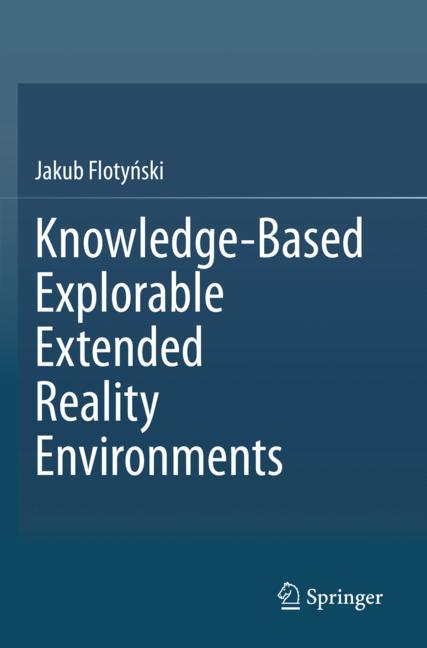
Knowledge-Based Explorable Extended Reality Environments
☆☆☆☆☆
(0 opinii)
Najniższa cena (z dostawą)
14 328,00 JPY
Typowa cena1 052,74 PLN
Najniższa (90 dni)71,50 PLN
Liczba ofert6
Ostatnia aktualizacja1 tydzień temu
Historia ceny (90 dni)
Pełna historia
2026-08-08
2026-08-15
| Zaktualizowano | Cena |
|---|---|
| 2026-08-08 | 84,99 |
| 2026-08-15 | 71,50 |
| Sprzedawca | Cena produktu | Dostawa | Razem | Dostępność | Aktualizacja | |
|---|---|---|---|---|---|---|
| SP SpringerNatureLink Shop INT | 14 299,00 JPY | 29,00 JPY | 14 328,00 JPY | Dostępny | 3 dni temu | Zobacz ofertę |
| SP Springer Nature Author | 14 299,00 JPY | 0 zł | 14 299,00 JPY | Dostępny | 1 tydzień temu | Zobacz ofertę |
| SP SpringerNatureLink Shop INT | 99,99 USD | 25,00 USD | 124,99 USD | Dostępny | 3 dni temu | Zobacz ofertę |
| SP SpringerNatureLink Shop INT | 109,99 USD | 15,00 USD | 124,99 USD | Dostępny | 3 dni temu | Zobacz ofertę |
| SP SpringerNatureLink Shop INT | 109,99 USD | 19,00 USD | 128,99 USD | Dostępny | 3 dni temu | Zobacz ofertę |
| SP SpringerNatureLink Shop INT | 118,00 EUR | 25,00 EUR | 143,00 EUR | Dostępny | 3 dni temu | Zobacz ofertę |
Ceny i dostępność mogą ulec zmianie. Ostatnia aktualizacja: 08.08.2026 23:20.
0,0
☆☆☆☆☆
0 opinii
5★
0%
4★
0%
3★
0%
2★
0%
1★
0%
Opinie o produkcie
Brak opinii — bądź pierwszy!
This book presents explorable XR environments—their rationale, concept, architectures as well as methods and tools for spatial-temporal composition based on domain knowledge, including geometrical, presentational, structural and behavioral elements. Explorable XR environments enable monitoring, analyzing, comprehending, examining and controlling users’ and objects’ behavior and features as well as users’ skills, experience, interests and preferences. The E-XR approach proposed in this book relies on two main pillars. The first is knowledge representation technologies, such as logic programming, description logics and the semantic web, which permit automated reasoning and queries. The second is imperative programming languages, which are a prevalent solution for building XR environments. Potential applications of E-XR are in a variety of domains, e.g., education, training, medicine, design, tourism, marketing, merchandising, engineering and entertainment. The book’s readers will understand the emerging domain of explorable XR environments with their possible applications. Special attention is given to an in-depth discussion of the field with taxonomy and classification of the available related solutions. Examples and design patterns of knowledge-based composition and exploration of XR behavior are provided, and an extensive evaluation and analysis of the proposed approach is included. This book helps researchers in XR systems, 3D modeling tools and game engines as well as lecturers and students who search for clearly presented information supported by use cases. For XR and game programmers as well as graphic designers, the book is a valuable source of information and examples in XR development. Professional software and web developers may find the book interesting as the proposed ideas are illustrated by rich examples demonstrating design patterns and guidelines in object-oriented, procedural and declarative programming.
Podobne produkty
 50 Years of Philosophy and Medicine
od $107.30
50 Years of Philosophy and Medicine
od $107.30
 Understanding Cybersecurity Law and Digital Privacy
od $122.63
Understanding Cybersecurity Law and Digital Privacy
od $122.63
 Decisions in International Trade and Logistics
od $122.63
Decisions in International Trade and Logistics
od $122.63
 Advances in Economic Measurement
od $122.63
Advances in Economic Measurement
od $122.63
 Nanomaterials
od $137.96
Nanomaterials
od $137.96
 Sustainable Scaffolds-based Strategies in Tissue Engineering and Regenerative Medicine
od $162.87
Sustainable Scaffolds-based Strategies in Tissue Engineering and Regenerative Medicine
od $162.87
 Narratives in Educational Research
od $162.87
Narratives in Educational Research
od $162.87
 Environmental Biology of the Young Chinese Sturgeon
od $210.78
Environmental Biology of the Young Chinese Sturgeon
od $210.78